

Does paying the minimum affect your credit score? Not the way you think. Pay on time and your score survives the month just fine. But keep doing it, and the damage shows up somewhere else entirely — in your utilization ratio, your interest bill, and how long that balance actually sticks around. Here’s the math nobody puts in front of you.
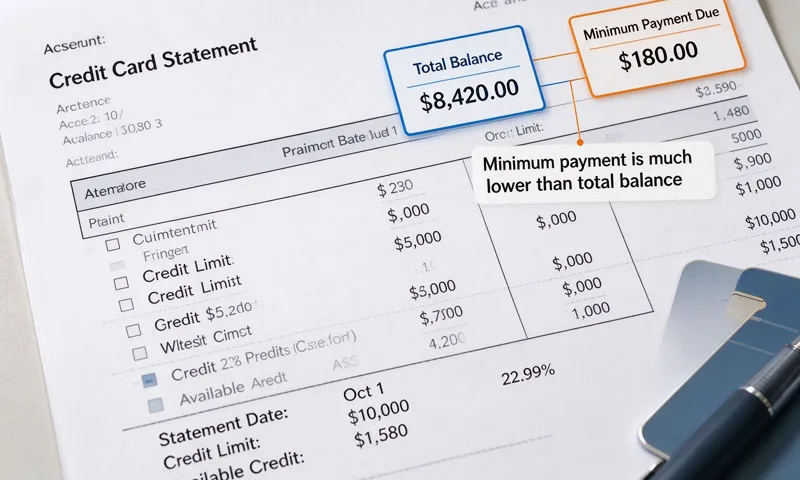
What Counts as a “Minimum Payment” (And Why It’s Not Fixed)
Your minimum isn’t a flat number. Most issuers set it as either a flat percentage of your balance — often 1% to 3% — or that same percentage plus new interest and fees layered on top. Some blend in any past-due amount too.
That’s why your minimum moves every cycle. Spend more, and it climbs. Carry a big balance one month, and next month’s minimum reflects it. Two cardholders with identical balances can owe completely different minimums, depending on which issuer sits behind the card.
How to Find Your Exact Formula
Check your cardholder agreement or the fine print on your statement. It’s usually a single sentence, something like “2% of the new balance or $25, whichever is greater.”
How credit card interest is calculated
Does Paying the Minimum Affect Your Credit Score? The Direct Answer
Short version: paying the minimum on time does not directly lower your score. FICO doesn’t penalize you for paying less than the full statement balance. It only cares whether you paid something by the due date.
The long version is where it gets interesting. Three things happen quietly in the background:
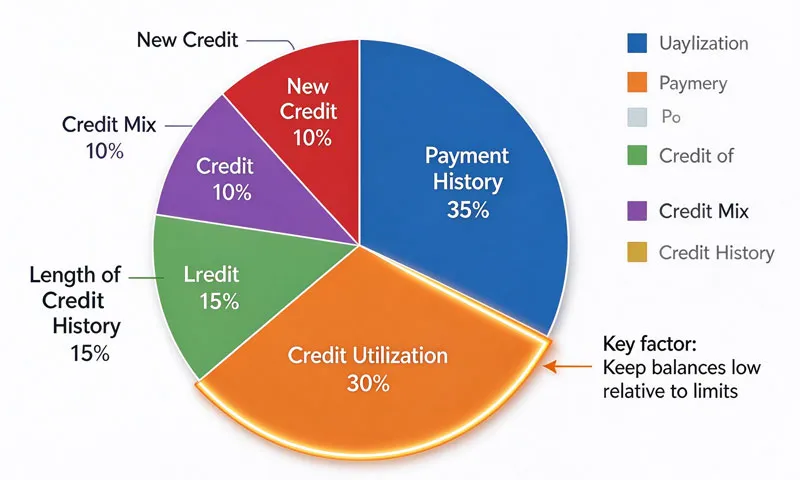
Credit utilization climbs. This is the big one. Utilization — the share of your credit limit you’re using — makes up 30% of a FICO score, second only to payment history. Pay the minimum, and your balance barely moves. Utilization stays high, month after month.
Payment history stays technically clean. As long as you’re on time, this factor — 35% of your score — looks fine on paper. But “fine” isn’t the same as “helping.”
Lenders read the pattern. Your score won’t flag it, but a new lender pulling your account history can see a balance that never shrinks. That shapes approval odds on your next mortgage or auto loan, even if the number itself looks stable.
The Real Math: What the Minimum Actually Costs
Numbers make this concrete. Take a $5,000 balance at 24.99% APR — close to the current average for accounts carrying a balance.
| Repayment approach | Monthly payment | Time to pay off | Total interest paid |
|---|---|---|---|
| Minimum only (starts ~$125, declines) | ~$125, shrinking | 20+ years | $8,000+ |
| Double the minimum | ~$250, fixed | Roughly 5 years | ~$3,200 |
| Fixed $300/month | $300 | About 20 months | ~$1,100 |
Same debt. Same starting point. The gap between rows one and three is thousands of dollars — money that never touches your principal, just your issuer’s revenue.
Average credit card interest rate
Credit Utilization: The Number Nobody Explains Clearly
Most advice says “keep utilization low.” Few say what low actually means.
Under 10% is where FICO models reward you most.
Under 30% keeps you out of the danger zone, but it’s not optimal — it’s just not actively hurting you.
Above 50% starts pulling scores down noticeably, especially if it’s consistent across several cards.
Here’s the part that trips people up: issuers usually report your statement balance to the bureaus, not your current balance. Pay it down mid-cycle, and your score won’t reflect that until the next statement closes. Timing matters more than most cardholders realize.
The Federal Minimum Payment Warning, Decoded
Since the Credit CARD Act of 2009, issuers must show a table on every statement estimating how long minimum-only payments would take to clear your balance, and what that costs in total interest. It also shows the payment needed to clear the balance in 36 months.
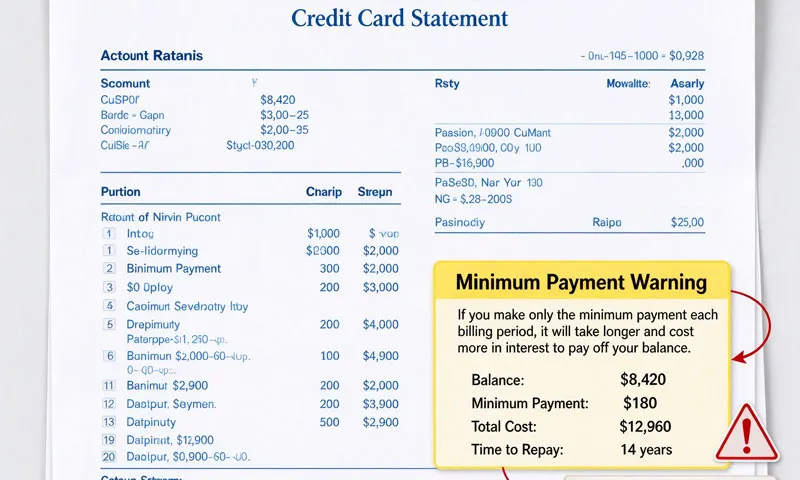
Most people skip straight past this box. It’s arguably the single most useful line on the entire statement — read it before you decide what to pay.
Who’s Most Exposed to the Minimum Payment Trap
New cardholders building credit. Small balance, full payoff each month beats minimum payments by a wide margin for score-building speed.
Anyone using credit to cover income gaps. The debt avalanche method — paying extra toward the highest-APR card first — saves the most in interest.
Cardholders already above 50% utilization. This is where a [balance transfer credit cards guide] or a call to your issuer about hardship terms actually moves the needle, faster than budgeting alone.
5 Ways to Break the Minimum Payment Habit
- Add a fixed extra amount — even $30 above the minimum compounds fast over a year.
- Use the avalanche method across multiple cards, targeting the highest APR first.
- Look at a 0% intro APR balance transfer if your utilization is high and your credit still qualifies.
- Call and ask for a lower APR. Issuers grant this more often than people expect, especially for accounts in good standing.
- Set autopay above the minimum, not at it. Removes the temptation entirely.
Debt avalanche vs snowball method
Frequently Asked Questions
Does paying exactly the minimum every month hurt my credit long-term?
Not directly, but the high utilization it creates usually does. Expect a lower score than someone paying the same balance down faster.
How fast does my score reflect a paid-down balance?
Usually after your next statement closing date, once the issuer reports the new balance to the bureaus.
Is there a difference between the minimum payment and the statement balance?
Yes. The statement balance is your full amount owed for the cycle. The minimum is the smallest fraction you can pay and stay current.
Can I negotiate my minimum payment with my issuer?
Sometimes, through hardship programs. It won’t lower your regular minimum, but it can adjust APR or payment terms temporarily.
Does paying the minimum on multiple cards compound the risk?
Yes. Utilization is calculated both per-card and across all your revolving accounts, so high balances on several cards stack the impact.
Key Takeaways
Paying the minimum keeps your account in good standing — nothing more. It doesn’t build credit, and left unchecked, it quietly inflates the interest you’ll pay and the utilization ratio lenders judge you on. The fix isn’t complicated: pay more than the minimum whenever you can, know your exact utilization number, and use tools like balance transfers strategically rather than as a last resort.
Disclaimer: This article is for informational purposes only and does not constitute financial, legal, or investment advice. Credit scoring models and issuer policies vary. Consult a licensed financial advisor or credit counselor for guidance specific to your situation.