

Does debt consolidation affect buying a home? Yes — it moves two numbers lenders care about most: your credit score and your debt-to-income ratio. The catch is timing. Consolidate at the wrong moment and you delay your mortgage approval. Consolidate at the right moment and you strengthen it. This guide breaks down exactly what underwriters check, how long recovery takes, and which consolidation methods help or hurt your homebuying timeline.
Reviewed for accuracy by a licensed mortgage professional. Last updated 2026.
What Is Debt Consolidation, and How Does It Work Before a Home Purchase?
Debt consolidation rolls multiple debts — credit cards, personal loans, medical bills — into one new loan with one payment. It doesn’t erase what you owe. It restructures it.
That distinction matters to lenders. Debt settlement reduces your balance but tanks your credit report with “settled” notations. Bankruptcy wipes debt but triggers a mandatory waiting period before you can even apply for a mortgage. Consolidation sits in the middle: no waiting period, no balance reduction, just a new credit profile to evaluate.
Debt Consolidation vs. Debt Settlement vs. Bankruptcy
| Factor | Debt Consolidation | Debt Settlement | Bankruptcy (Ch. 7) |
|---|---|---|---|
| Reduces balance owed | No | Yes | Yes |
| Credit report impact | Temporary dip | “Settled” flag, long-term damage | Public record, 7-10 years |
| Mortgage waiting period | None | None, but score damage lingers | 2-4 years typically |
| Underwriter red flag risk | Low, if managed well | High | Moderate, improves with time |
Common Types of Debt Consolidation Loans
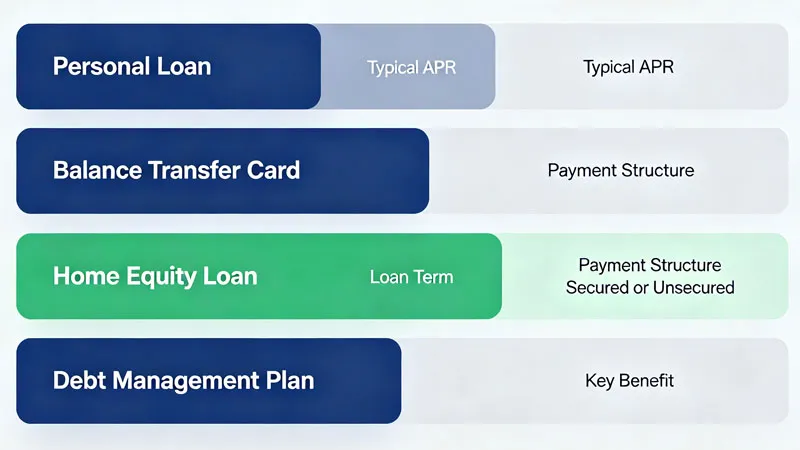
- Personal loans — fixed rate, fixed term, no collateral
- Home equity loans / HELOCs — lower rates, but they use your house as collateral, which changes your homebuying math if you’re borrowing against a property you already own
- Balance transfer cards — 0% intro APR, but fees apply and the rate jumps hard once the promo period ends
- 401(k) loans — no credit check, but [401(k) loan repayment rules] requires full repayment if you leave your job, sometimes within 60-90 days
How Debt Consolidation Affects Your Debt-to-Income Ratio for a Mortgage
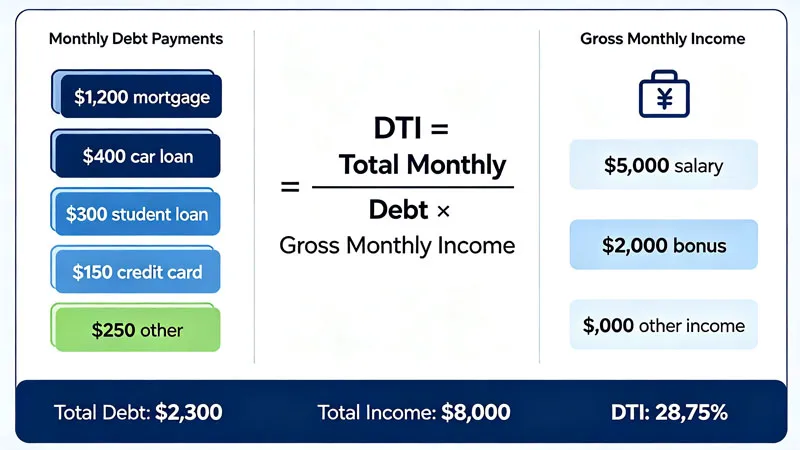
DTI is the percentage of your gross monthly income going toward debt. Lenders use it to decide how much mortgage you can safely carry.
What DTI Do Mortgage Lenders Actually Require?
| Loan Type | Max DTI (typical) |
|---|---|
| Conventional | 36-45% |
| FHA | Up to 50% with compensating factors |
| VA | No hard cap, but 41% is a common benchmark |
| USDA | 41% |
When a Lower Payment Still Raises Your DTI
Here’s the trap nobody explains: a lower monthly payment doesn’t automatically mean a lower DTI.
Say you owe $50,000 across five accounts, paying $1,500 a month combined. You consolidate into a 10-year loan at $500 a month. Your payment drops. But if that new loan extends your total debt timeline and you add any new credit in the process, your DTI calculation can shift in ways that don’t match your gut sense of “I’m paying less now.”
Run the math before you sign: (new monthly debt payments + estimated mortgage payment) ÷ gross monthly income. If that number sits above your target loan program’s ceiling, consolidating won’t fix your approval odds — it just changes which number is the problem.
How Debt Consolidation Impacts Your Credit Score
Why Your Score Dips Right After Consolidating
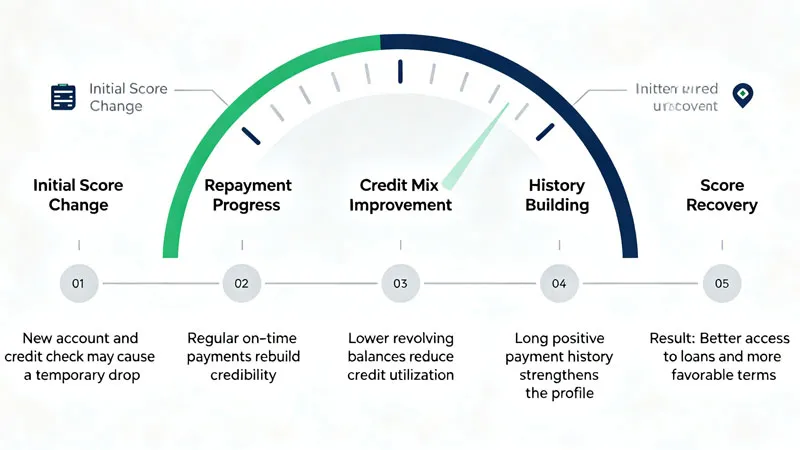
Three things hit at once: a hard inquiry, a new account with zero age, and a shift in your credit utilization as old balances close. Expect a temporary drop, not a permanent one.
The “Settled” vs. “Paid in Full” Trap
If your consolidation involves any negotiated settlement rather than a straight payoff, your creditor may report the account as “settled for less than owed.” Automated underwriting systems flag this differently than a clean “paid in full” status — it reads as a signal of past repayment trouble, even if your current finances are solid.
Credit Score Recovery Timeline
- Month 1 — score dips from the hard inquiry and new account
- Month 3 — utilization stabilizes, minor recovery begins
- Month 6 — most lenders want to see six months of on-time payments here
- Month 12 — score typically recovers past pre-consolidation levels if payments stayed consistent
How Long After Debt Consolidation Can You Buy a House?
There’s no universal waiting period, but most lenders want six to twelve months of clean payment history before they’ll approve a mortgage with confidence. FHA and VA lenders tend to be more flexible than conventional lenders here. Ask your loan officer about their specific overlay requirements — they vary by lender, not just by loan program.
Does the Type of Consolidation Loan Change Your Approval Odds?
HELOCs Carry a Hidden Risk
Using home equity to consolidate debt puts your current house on the line and reduces the equity you could otherwise use toward a future down payment or move-up purchase. If you’re planning to sell and buy again soon, a HELOC eats into your available proceeds.
401(k) Loans and Underwriting
Some underwriters count 401(k) loan repayments against your DTI if they appear as a payroll deduction. Others don’t, since it’s technically your own money. Ask your lender directly — this one varies.
Balance Transfer Cards
Lenders generally view these the same as any revolving credit account. The intro rate doesn’t matter to underwriting; the balance and minimum payment do.
What to Check Before Consolidating If You Plan to Buy Soon
- Will this loan reduce your down payment savings?
- Does the lender report the account as installment or revolving — this affects your DTI math differently
- Are there prepayment penalties that lock you into a longer repayment window?
- Will closing old accounts shorten your average credit age right before an application?
how to improve your credit score before applying for a mortgage
Mistakes That Delay Your Home Purchase
Homebuyers consistently make three errors after consolidating: closing every old account at once, applying for mortgage pre-approval within weeks of the new loan, and ignoring prepayment penalty clauses that quietly extend their repayment obligation. Each one adds months to the timeline unnecessarily.
debt-to-income ratio calculator for homebuyers
FAQ
Can I buy a house right after debt consolidation?
Technically yes, but most lenders want to see several months of on-time payments first. Applying immediately after consolidating often results in a lower approval amount or a higher rate.
Does debt consolidation hurt my pre-approval chances?
It can, temporarily. The hard inquiry and new account lower your score short-term, but responsible repayment usually offsets this within six months.
Is debt consolidation better than bankruptcy if I want to buy a home?
For most buyers, yes — there’s no mandatory waiting period like there is after bankruptcy. But if your debt-to-income ratio is unmanageable even after consolidating, bankruptcy might get you to a clean slate faster.
Should I consolidate debt or save for a down payment first?
It depends on your DTI. If high debt payments are blocking your mortgage approval entirely, fix that first. If your DTI already qualifies, prioritize the down payment.
Final Thoughts
Debt consolidation isn’t automatically good or bad for your home-buying timeline. It depends on the loan type you choose, how you manage the new payment, and how much runway you give your credit to recover before applying. [talk to a mortgage advisor about your options] before making the move if you’re within a year of buying.
Disclaimer: This article is for informational purposes only and does not constitute financial, legal, or lending advice. Mortgage requirements vary by lender and loan program. Consult a licensed mortgage professional, financial advisor, or attorney for guidance specific to your situation.