

You forgot your business card at a client dinner. You swiped your personal one instead. Now you’re wondering: can you use a personal credit card for business without creating a mess at tax time? The short answer is yes—but the real cost depends on how your company is structured, and most guides skip that part entirely.
Can You Use a Personal Credit Card for Business Expenses?
Yes. Nothing in federal law stops you from paying a vendor invoice or a software subscription with your personal Visa. The IRS doesn’t care which card you swipe. What matters is whether the expense is ordinary and necessary for your business, and whether you can prove it later.
That said, “legal” and “wise” are two different questions. The risk isn’t the transaction itself—it’s what happens when personal and business money live in the same place for months or years.
Disclaimer: This article is for general information only. It doesn’t constitute legal, tax, or financial advice. Talk to a licensed CPA or business attorney before making decisions about your specific entity structure.
Is It Legal? It Depends on Your Business Entity
This is where most articles stop at a generic “yes.” But your entity type changes the actual stakes.
Sole Proprietors: The Risk Barely Applies to You
If you’re a sole proprietor, there’s no legal wall between you and your business to begin with. You’re already personally liable for business debts, card or no card. Using a personal card doesn’t add new exposure—it just makes your books messier.
LLCs: Where “Piercing the Corporate Veil” Becomes Real
This is different for an LLC. Courts can disregard your liability shield entirely if they find your personal and business finances are indistinguishable. Legal teams call this piercing the corporate veil, and commingled credit card spending is one of the fastest ways to trigger it.
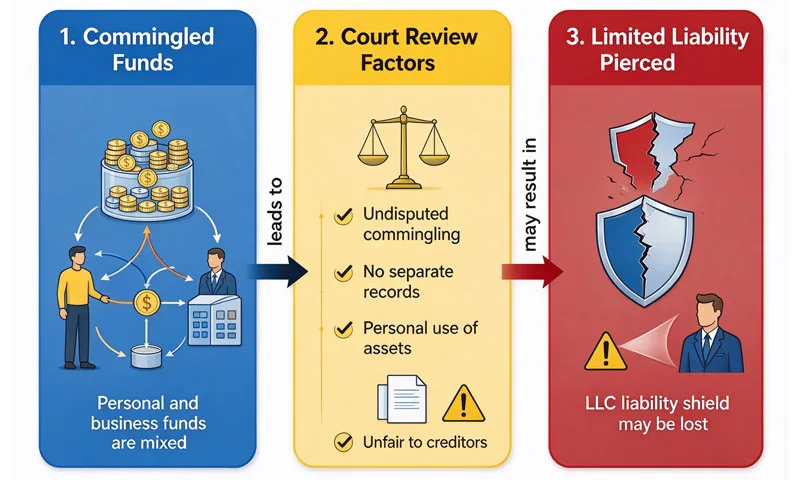
A judge looking at a lawsuit against your LLC will ask a simple question: did you actually treat this business as separate from yourself? If your personal card is funding inventory, payroll, and your Netflix subscription on the same statement, the answer looks like no.
S-Corps and C-Corps: Higher Scrutiny, Higher Stakes
Corporations face even stricter expectations around corporate formalities—separate accounts, documented transactions, clean board records. Auditors and courts hold corporations to a higher bar than LLCs when it comes to proving the entity is real and not just a legal wrapper.
| Entity Type | Liability Shield Risk | What You Should Do |
|---|---|---|
| Sole Proprietorship | Not applicable—no separation exists | Keep clean records for tax purposes |
| LLC | High—veil piercing is a genuine threat | Move to a dedicated business card |
| S-Corp / C-Corp | Highest—formal governance expected | Separate accounts are close to mandatory |
LLC liability protection guide
Can You Deduct Business Expenses Paid With a Personal Card?
Yes, and this trips up a lot of business owners. The deduction isn’t tied to which card you used—it’s tied to whether the expense meets the IRS standard of being ordinary and necessary for your trade or business.
IRS ordinary and necessary business expense standard
What actually raises audit risk isn’t the payment method. It’s poor documentation. An expense buried in a personal statement next to your grocery run and a birthday gift is harder to substantiate than one sitting cleanly on a dedicated business card.
A Real Bookkeeping Example
Say you pay a $500 software subscription on your personal card. Here’s how that flows into your books if you don’t reimburse yourself immediately:
- Debit: Software Expense — $500
- Credit: Owner’s Contribution (Equity) — $500
If the business later repays you, you’d instead log it as a reimbursement liability until the payment clears. This distinction matters for your balance sheet, and it’s the step most guides gloss over entirely.
How to Record Business Expenses Paid With a Personal Credit Card
Follow the same four steps every time, and reconciliation stops being a monthly headache.
- Capture it immediately. Connect the card to your accounting software so nothing gets lost in a drawer of paper receipts.
- Categorize it correctly. Code it to the right expense line the moment it hits your books, not three months later.
- Record it properly. Log it as an owner contribution or a formal reimbursement, never as an unlabeled transfer.
- Reconcile monthly. Match statements against your books and keep itemized receipts in case of an audit.
Small business bookkeeping software comparison
The Real Risks of Mixing Personal and Business Credit
Beyond the legal exposure, commingled spending creates practical damage:
- Weaker dispute rights. Consumer protections under the Credit CARD Act apply differently once a purchase is for business use.
- Slower tax prep. Every mixed statement means proving business purpose line by line during filing.
- No business credit built. Personal cards don’t report to Dun & Bradstreet or Experian Business, so you’re not building the credit profile that gets you better financing later.
- Employee friction. When staff front business costs on their own cards, reimbursement delays hit their personal cash flow and their morale.
Business credit reporting to Dun and Bradstreet
When a Personal Card for Business Actually Makes Sense
There are legitimate short-term uses:
- No credit history yet. A brand-new business often can’t qualify for a strong business card right away.
- One-off emergencies. You forgot your corporate card at dinner. It happens.
- Bridging the gap. You’re waiting on business card approval and need to make a time-sensitive purchase.
- 0% intro APR balance transfers. Business balance-transfer cards are rare, so a personal 0% card can be a smart short-term debt tool.
Treat every one of these as temporary. If you’re still relying on a personal card past the 90-day mark, it’s time to apply for a dedicated business card.
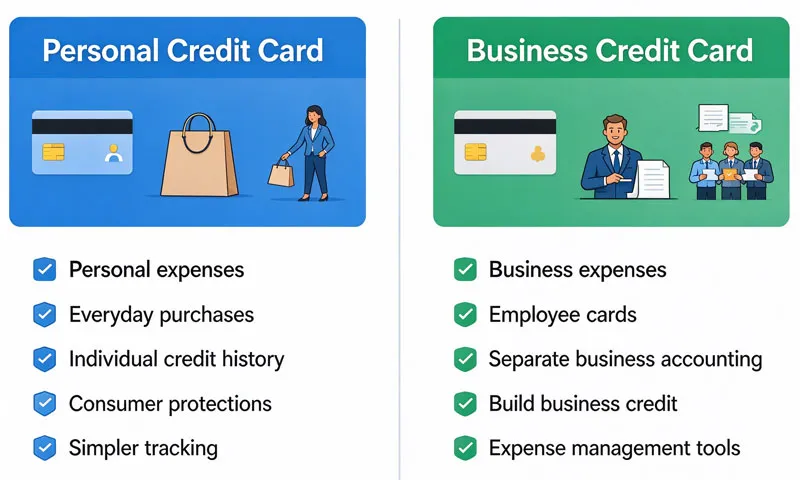
Personal Credit Card vs. Business Credit Card
| Feature | Personal Card | Business Card |
|---|---|---|
| Builds business credit | No | Yes |
| Liability protection | None | Partial, varies by issuer |
| Free employee cards | Rare | Common |
| Expense automation | Manual | Auto-categorized |
| Audit documentation burden | Higher | Lower |
| Typical credit limit | Lower | Higher |
Frequently Asked Questions
Can I use my personal credit card for my LLC?
Yes, but it weakens your liability protection over time. Move to a dedicated business card as soon as your LLC has any real transaction volume.
Is it illegal to use a personal credit card for business?
No. There’s no law against it. The risk is financial and legal exposure, not criminal liability.
Can you use a business credit card for personal expenses?
Technically yes, but it breaches most card agreements and creates the same commingling risk in reverse.
Does using a personal card for business hurt my credit score?
Only if you run up your utilization ratio or miss payments. Business spending on a personal card behaves exactly like any other charge on your credit report.
How long can I use a personal card before it hurts my LLC’s protection?
There’s no fixed legal timeline, but the longer your finances stay mixed, the weaker your defense looks if a court ever reviews it. Most advisors recommend transitioning within your first 90 days of real revenue.
EIN-only business credit card options
Disclaimer: This article is for general informational purposes only and does not constitute legal, tax, or financial advice. Please consult a licensed CPA or business attorney to evaluate your specific business situation before making any decisions.