

An 800 credit score puts you in the top tier of American borrowers — and the financial advantages are substantial. Better mortgage rates, premium credit card approvals, lower auto loan APRs. Yet most people have no clear plan to get there. This guide breaks down exactly how credit scores are calculated, what an 800 score is actually worth in dollars, and a step-by-step roadmap tailored to where you’re starting from right now.
What Does an 800 Credit Score Actually Mean?
The Scoring Scale — and Where 800 Lands
Both FICO and VantageScore use a 300–850 range. Here’s how the tiers break down:
| Score Range | FICO Label | What It Signals |
|---|---|---|
| 300–579 | Poor | High-risk borrower |
| 580–669 | Fair | Below average |
| 670–739 | Good | Near prime |
| 740–799 | Very Good | Low risk |
| 800–850 | Exceptional | Top-tier borrower |
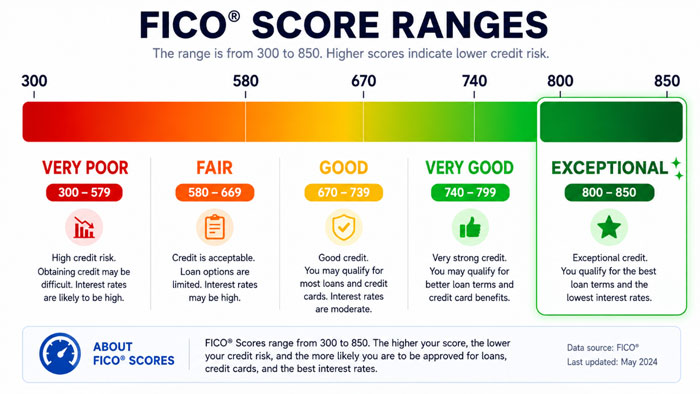
One thing worth knowing upfront: you don’t need a perfect 850. Once you’re at 800, lenders treat you nearly identically to someone at 850. The practical ceiling is 800, not 850.
How Rare Is an 800 Credit Score?
According to [Experian’s State of Credit report], roughly 23% of U.S. consumers currently hold a credit score above 800. That’s a meaningful minority — achievable, but not automatic. Another 28% sit in the “Very Good” range, meaning millions of people are a few smart moves away from crossing that threshold.
How Your Score Is Calculated
FICO’s official score breakdown
Your FICO score is built on five factors:
- Payment History — 35%: Your track record of paying on time
- Amounts Owed (Utilization) — 30%: How much of your available credit you’re using
- Length of Credit History — 15%: The age of your oldest and average accounts
- Credit Mix — 10%: Whether you have both revolving and installment credit
- New Credit — 10%: How many recent applications you’ve made
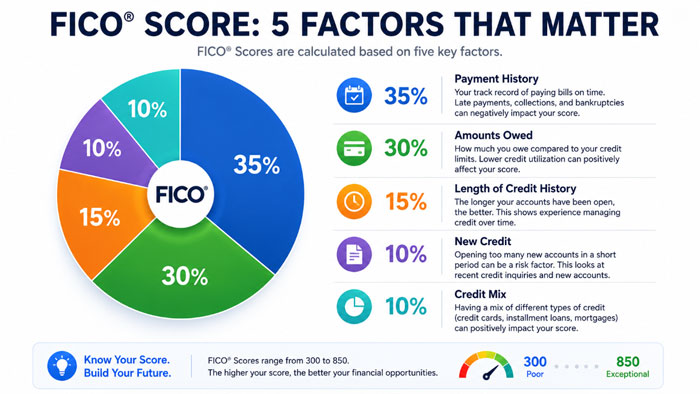
VantageScore uses slightly different weights, but the same fundamentals apply. Master these five levers and you master your score.
The Real Dollar Value of an 800 Credit Score
What an 800 Score Saves You on a Mortgage
This is where an exceptional credit score moves from abstract to concrete. Consider a $400,000 30-year fixed mortgage:
| Credit Score Tier | Estimated Rate* | Monthly Payment | Total Interest Paid |
|---|---|---|---|
| 620–639 | ~7.4% | ~$2,763 | ~$595,000 |
| 700–719 | ~6.9% | ~$2,640 | ~$550,000 |
| 760–779 | ~6.5% | ~$2,528 | ~$510,000 |
| 800–850 | ~6.3% | ~$2,474 | ~$490,000 |
*Rates are illustrative estimates based on historical spread data. Actual rates vary by lender, loan type, and market conditions. Always compare live quotes from multiple lenders.
The difference between a 620 score and an 800 score on that same mortgage? Over $100,000 in total interest. That’s not a minor perk — that’s a life-altering financial difference.
Other Benefits Worth Knowing
Premium credit card access. The top rewards cards — those with the best cash back, travel perks, and sign-up bonuses — require excellent credit. An 800 score puts every card on the table.
Lower auto loan APRs. Borrowers with exceptional credit scores typically qualify for APRs several points below the national average, which according to Experian currently hovers around 5–6% for new vehicles for prime borrowers.
Non-financial advantages. Landlords routinely pull credit reports before approving applications. Some employers do too — though under the Fair Credit Reporting Act (FCRA), employers can only view your credit report, not your actual score, and must get your written consent first. This is a legal detail most personal finance articles skip entirely.
Your Personalized Roadmap: From Your Current Score to 800
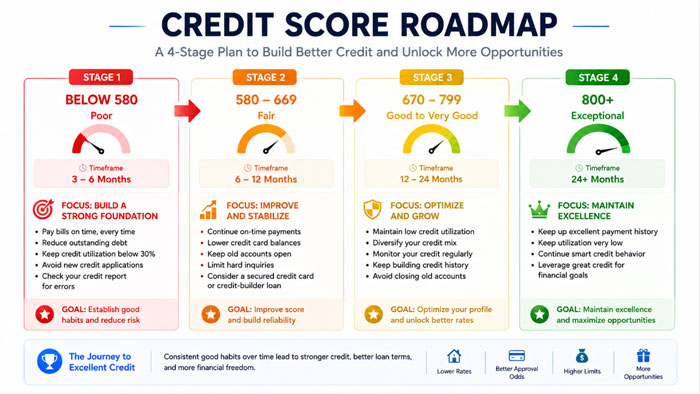
Most articles give one-size-fits-all advice. That’s not useful. Where you start determines what to prioritize first.
Score-Based Action Plan
| Current Score | Top Priority Action | Realistic Timeline to 800 |
|---|---|---|
| Below 580 | Open secured card + dispute report errors | 24–36 months |
| 580–669 | Reduce utilization + rebuild payment history | 18–24 months |
| 670–739 | Optimize credit mix + request limit increases | 12–18 months |
| 740–799 | Fine-tune utilization timing + protect account age | 6–12 months |
How Long Does It Actually Take?
The honest answer: it depends on three variables.
- Your starting score. Someone at 750 can realistically hit 800 in under a year with disciplined utilization management. Someone recovering from a serious delinquency is looking at a longer runway.
- Negative items on your report. Late payments stay on your credit report for seven years. Bankruptcies stay for 7–10 years. These aren’t instantly fixable — but their impact on your score does diminish over time.
- Your credit age. This one simply takes time. There’s no shortcut to having a 10-year-old account.
The Five Pillars — And How to Optimize Each One
Pillar 1: Payment History (35%) — Build a Zero-Miss Record
One missed payment can drop an 800 score by 50–100 points, according to FICO modeling data. That’s how sensitive the top tier is.
The fix is simple but non-negotiable: automate everything. Set up autopay for the minimum on every account, then pay the full balance manually each month. The autopay acts as a safety net.
A nuance most people miss: most creditors won’t report a late payment until it’s 30 days past due. A payment that’s three days late won’t necessarily hurt you. That said, don’t test it — grace periods vary by issuer.
Pillar 2: Credit Utilization (30%) — The 7% Rule
People with 800+ scores carry an average credit utilization of around 7.7%, per Experian data. That’s not a coincidence.
The standard advice is “stay under 30%.” To hit 800, aim for under 10% — and ideally under 7% across all accounts.
The statement date problem — and why your score might be unfairly penalized:
Credit card issuers typically report your balance to the bureaus around your statement closing date, not your payment due date. So if you charge $3,000 on a $5,000-limit card and your statement closes before you pay it off — even if you always pay in full — the bureau sees 60% utilization that month.
The solution: pay your balance down before your statement closing date, not just before your due date. Or make two payments per month to keep your reported balance low at all times.
credit utilization ratio calculator
Pillar 3: Length of Credit History (15%) — Protect Your Anchors
Your oldest credit accounts are your most valuable assets. Never close them without a strong reason.
The authorized user strategy can accelerate credit history — but it carries a risk most guides ignore. Becoming an authorized user on a family member’s account works both ways. If that account has high utilization or a missed payment history, it can hurt your score, not help it. Verify the account’s full history before asking to be added.
Pillar 4: Credit Mix (10%) — Show You Can Handle Both Types
Lenders want to see that you can manage both revolving credit (credit cards — open-ended, flexible) and installment credit (mortgages, auto loans, student loans — fixed monthly payments with an end date).
If your credit file only contains credit cards, some lenders — particularly for large installment loans — may still hesitate, even at an 800 score. This doesn’t mean taking on debt you don’t need. But if you’re already considering a purchase that requires financing, a well-managed installment loan helps your profile.
Pillar 5: New Credit (10%) — Hard vs. Soft Inquiries Explained
This is one of the most misunderstood areas of credit management.
| Inquiry Type | When It Happens | Affects Your Score? | Stays on Report |
|---|---|---|---|
| Hard Inquiry | You apply for a card, loan, or mortgage | Yes — typically -5 to -10 pts | 2 years |
| Soft Inquiry | You check your own score; employer checks; pre-approval offers | No | Not visible to lenders |
Rate-shopping for a mortgage or auto loan within a 14–45 day window counts as a single hard inquiry under FICO’s deduplication rules. Use that window strategically when comparing lenders.
Five Mistakes That Keep People Below 800
- Closing old credit card accounts. It shortens your average account age and can reduce your total available credit — both hurt your score.
- Applying for multiple cards in a short window. Each application triggers a hard inquiry and signals financial stress to lenders.
- Ignoring credit report errors. The FTC has found that roughly one in four Americans has an error on at least one credit report. Errors don’t fix themselves.
- Trusting credit repair companies. Under the Credit Repair Organizations Act (CROA), no company can legally remove accurate negative information from your credit report — regardless of what they promise. Any company claiming otherwise is misrepresenting what they can do. You can dispute errors yourself, for free, directly through the three bureaus.
- Confusing your score with your report. Your score is the number. Your report is the underlying data that generates it. Errors in the report can tank the score. Always check both.
Tools to Monitor Your Credit Score (Updated 2026)
| Tool | Score Type Provided | Update Frequency | Notable Feature |
|---|---|---|---|
| Experian Free | FICO Score 8 | Monthly | Official FICO; flags score changes |
| Credit Karma | VantageScore 3.0 | Weekly | Free report access; approval odds |
| Discover ScoreCard | FICO Score 8 | Monthly | No Discover account required |
| Chase Credit Journey | VantageScore 3.0 | Weekly | Identity monitoring included |
Checking your own score through any of these tools is a soft inquiry — it has zero effect on your score. Check as often as you want.
Maintaining an 800 Score Long-Term
Reaching 800 is a milestone. Staying there is a system.
Annual credit health checklist:
- Pull all three credit reports from AnnualCreditReport.com — the only federally authorized free source
- Verify no unauthorized accounts have been opened
- Confirm utilization across all accounts is below 10%
- Check that all payment history entries are accurate
- Review the age of your oldest account — and confirm you haven’t accidentally closed it
Think of it less like a score to chase and more like a financial vital sign to maintain. The habits that build 800 are the same habits that keep it.
Frequently Asked Questions
Yes — but it’s uncommon, because credit history length accounts for 15% of your score. If you opened your first card at 18, maintained perfect payment history, and kept utilization low, a score above 750 is very achievable by your mid-20s. Hitting 800 typically requires a longer track record, though it’s possible with a strong foundation and an authorized user boost from a parent’s established account.
A single missed payment can drop an 800-tier score by 50–100 points. Recovery depends on the severity — a one-time 30-day late typically loses most of its impact within 12–24 months of consistent on-time payments. The negative mark itself stays on your report for seven years but carries diminishing weight over time.
No. Self-checks are soft inquiries and have no effect on your score. Only applications for new credit (hard inquiries) affect it.
They’re calculated differently and often show different numbers for the same person. FICO Score 8 is the most widely used by lenders — roughly 90% of top lenders use a FICO model. VantageScore is useful for monitoring trends, but FICO is typically what lenders see when you apply for credit.
They can help you organize and submit dispute letters — but nothing a credit repair company does is something you can’t do yourself for free. More importantly, under the Credit Repair Organizations Act, they cannot legally remove accurate negative information. If a company guarantees it can wipe your record clean, that’s a red flag.
The Bottom Line
An 800 credit score is within reach for most people who understand the five underlying factors and manage them consistently. It’s not about gaming the system — it’s about building financial habits that happen to be exactly what credit scoring models reward: pay on time, use less than 10% of available credit, keep old accounts open, and check your reports for errors every year.
The earlier you start, the faster you get there. The longer you maintain it, the more it compounds — in lower interest rates, better loan terms, and options that simply aren’t available to borrowers with average credit.
Disclaimer: This article is for informational purposes only and does not constitute financial, legal, or credit counseling advice. Credit scoring models, interest rates, and lender requirements vary and are subject to change. Consult a licensed financial advisor or credit counselor for guidance specific to your situation.