

Learning how to start over financially isn’t about willpower. It’s about having a plan that survives real life. If your last attempt fell apart, you’re not the problem — your approach probably was. This guide walks through what actually works, backed by real numbers and real timelines, not vague encouragement.
What Does “Starting Over Financially” Actually Mean?
A financial reset isn’t a New Year’s resolution. It’s a structured process: you assess where you stand, figure out what broke last time, and rebuild with better tools. People usually need one after a divorce, a layoff, a bankruptcy, or a business failure. Sometimes there’s no single trigger — just a slow realization that the numbers don’t add up anymore.
The 4 Triggers That Usually Prompt a Reset
- Divorce or separation — shared debt, split assets, new solo budget
- Job loss or income drop — emergency fund gets tested immediately
- Major debt event — bankruptcy, settlement, or maxed-out credit
- Career pivot — new business, freelance income, irregular cash flow
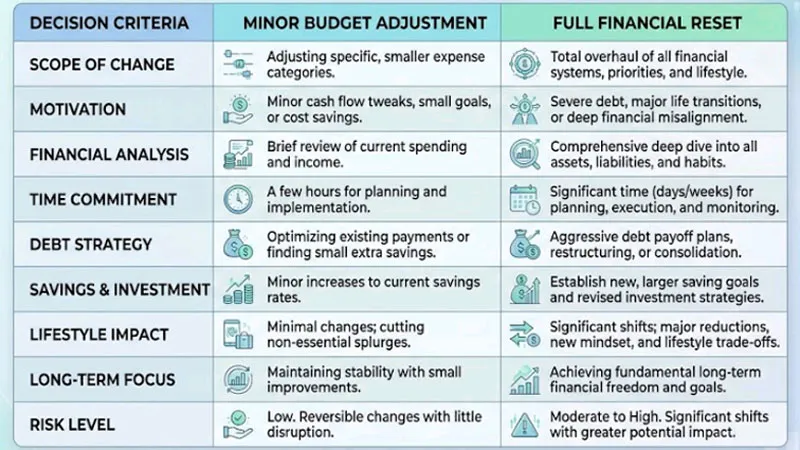
Reset vs. Adjustment: Know the Difference
Not every rough month means you need to start over. A reset is warranted when your net worth trend has been negative for over a year, or your goals have fundamentally changed.
Step 1: Get an Honest Snapshot of Your Money
You can’t rebuild what you haven’t measured. Pull every account — checking, savings, credit cards, loans, retirement — and calculate your net worth: assets minus liabilities.
For context, median household net worth in the U.S. was roughly $192,900 as of the Federal Reserve’s most recent Survey of Consumer Finances. That number won’t match your situation, but it gives you a benchmark instead of guessing in the dark. [Federal Reserve Survey of Consumer Finances]
Pull Your Credit Report Correctly
Checking your own credit report is a soft inquiry — it does not lower your score. Hard inquiries only happen when a lender checks your credit for a new account. Pull your free report through [how to check your credit report] and look for errors, old accounts, or signs of fraud.
List Every Debt With Its Real Terms
Don’t just total your debt. Write down each balance, its interest rate, and its minimum payment. That’s the data you’ll need for step four.
Step 2: Figure Out Why the Last Attempt Failed
Most resets don’t fail because of bad math. They fail because of predictable behavioral patterns.
The 3 Most Common Reasons Resets Don’t Stick
- Present bias — prioritizing today’s comfort over next year’s goal
- Planning fallacy — underestimating how long habits take to form
- No recovery plan — one bad month feels like total failure, so people quit
Behavioral economists at the Consumer Financial Protection Bureau have documented how automatic, low-friction systems consistently outperform willpower-based plans. [CFPB behavioral finance research]
Treat missed payments and overspending as data points, not verdicts. A missed goal tells you where the plan didn’t match your real life — not that you’re bad with money.
Step 3: Set Goals That Survive Real Life
Vague goals like “save more” don’t work. SMART goals do.
Example: “Pay off $2,400 in credit card debt by December 1 with $400 monthly payments, no new charges.”
Balance Short- and Long-Term Goals
Pick one goal you can hit this year and one that takes three to five years — retirement, a home down payment, or a fully funded emergency fund.
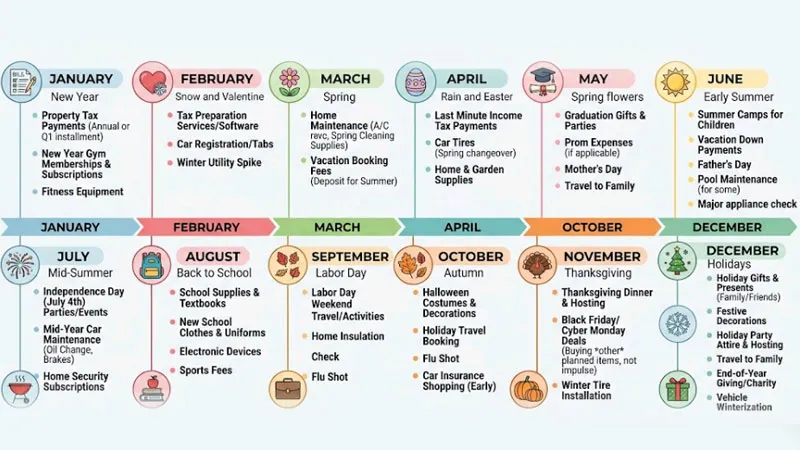
Plan for the Expenses Most Budgets Miss
Annual costs sink more resets than daily spending does: car registration, holiday gifts, HVAC servicing, annual insurance premiums. Set aside a small monthly amount now so these bills don’t blow up your plan later.
Step 4: Build a Budget You’ll Actually Follow
50/30/20 vs. Zero-Based Budgeting
| Method | Best For | Trade-off |
|---|---|---|
| 50/30/20 Rule | Beginners, stable income | Less precise for debt payoff |
| Zero-Based Budget | Aggressive debt payoff, irregular income | Requires more monthly tracking |
If you’re just starting over, the 50/30/20 rule is easier to sustain. If you’re carrying significant debt, zero-based budgeting forces every dollar to work harder.
Leave room for small discretionary spending. A budget with zero flexibility usually breaks within two months.
Step 5: Protect the Reset From Relapse
This is the step most guides skip — and it’s the one that actually determines whether your reset lasts.
Automate Before You Rely on Willpower
Set up automatic transfers to savings and automatic minimum payments on every debt. Willpower fades. Automation doesn’t.
Build a Check-In You’ll Keep
A monthly 20-minute money review beats a daily obsession you’ll abandon by week three. Put it on your calendar like any other appointment.
When to Bring in a Professional
- Financial coach — behavior and habit change, not licensed advice
- Credit counselor (often nonprofit, free) — debt management plans, creditor negotiation
- Financial advisor (licensed, often fee-based) — investment and retirement strategy
If you’re overwhelmed, [how to choose a financial advisor] can help you match the right professional to your situation.
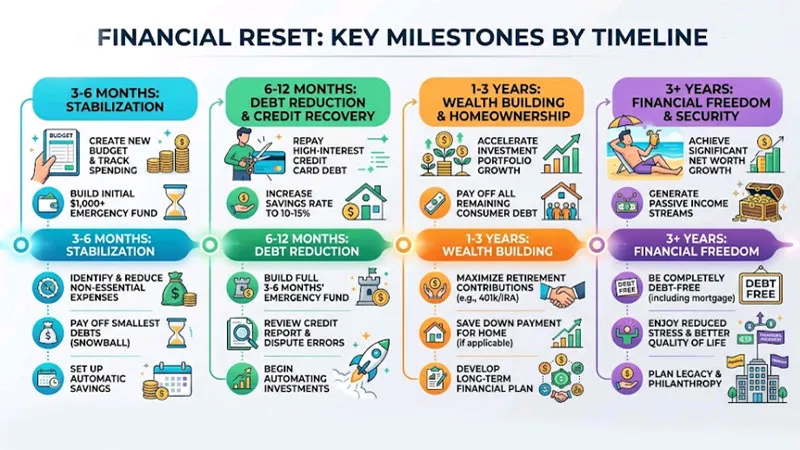
How Long Does It Actually Take to Start Over Financially?
This is the question most guides never answer directly.
- Rebuilding an emergency fund: 6–12 months for a starter fund of $1,000–$2,000
- Improving a damaged credit score: 3–6 months for early movement, 12–24 months for significant recovery
- Paying off moderate credit card debt: 18–36 months with consistent payments
- Feeling “stable” again: most people report a meaningful shift around the 12-month mark
Starting Over at Different Life Stages
In Your 20s and 30s
You have time on your side. Focus on building habits — automatic savings, a simple budget, and starting retirement contributions even at a small percentage.
In Your 40s
Starting over financially at 40 usually means balancing two urgent goals at once: paying down debt and catching up on retirement contributions. The IRS allows higher catch-up contribution limits starting at age 50, so this decade is about building momentum before that window opens. [IRS retirement contribution limits]
After Divorce, Job Loss, or Business Failure
Separate emotional decisions from financial ones where you can. Get a temporary budget in place first — the long-term plan can wait 60–90 days while you stabilize.
Frequently Asked Questions
Is it normal to have to start over more than once financially?
Yes. Most people go through multiple resets across their lifetime, usually tied to major life changes. One reset doesn’t mean you failed — it means your circumstances shifted.
Does checking your own credit report hurt your score?
No. Checking your own credit is a soft inquiry and has no impact on your score. Only hard inquiries from lenders affect it, and only slightly.
What’s the difference between a financial coach and a financial advisor?
A financial coach helps with habits, mindset, and budgeting systems but isn’t licensed to give investment advice. A financial advisor is licensed and typically handles investment and retirement planning.
How much emergency savings do I need before paying off debt aggressively?
Most planners recommend a starter fund of $1,000–$2,000 before aggressive debt payoff, then building to 3–6 months of expenses once high-interest debt is cleared.
Can a financial reset hurt my credit score in the short term?
Closing old accounts or missing payments during a transition can dip your score temporarily. Paying on time and keeping old accounts open usually offsets this within a few months.
This article is for informational purposes only and does not constitute financial, legal, or tax advice. Consult a licensed financial advisor, credit counselor, or tax professional before making decisions specific to your situation.