

Real estate exit strategies decide whether your deal makes money or just ties up your cash. Most investors plan the purchase in detail and figure out the exit later — that’s backwards. This guide breaks down nine proven exits, the tax rules nobody mentions, and how to pick the right one before you sign anything.
Key Takeaways
✔ Your exit strategy should be locked in before you make an offer, not after closing.
✔ 1031 exchanges have hard deadlines — miss them and you lose the tax deferral entirely.
✔ Seller financing carries federal compliance rules most sellers don’t know exist.
✔ The “best” strategy depends on your timeline, capital, and risk tolerance — not market hype.
✔ Short-term flips get taxed differently than long-term holds. That difference is often five figures.
What Is a Real Estate Exit Strategy?
Definition: A real estate exit strategy is the specific plan an investor uses to convert a property into cash or reinvested capital — whether through sale, refinance, or a structured transfer of ownership.
An exit strategy is not the same as a closing. A closing is the transaction that starts your hold period. An exit is the transaction that ends it. Confusing the two leads investors to under-plan for the moment that actually determines their return.
Why You Need This Decided Before You Buy
Lenders, contractors, and timelines all shift depending on your exit. A flip needs different financing than a buy-and-hold. If you don’t know your exit going in, you’re guessing at every decision that follows.
Real estate investment financing options
How to Choose the Right Exit Strategy
Ask five questions before you commit:
- Timeline — Do you need cash in 30 days or are you comfortable holding for 5 years?
- Capital reserves — Can you absorb a vacancy or a failed sale?
- Risk tolerance — Are you okay with construction delays and rate shifts?
- Property condition — Light cosmetic fixes or a full gut renovation?
- Tax position — Are you trying to defer gains or take income now?
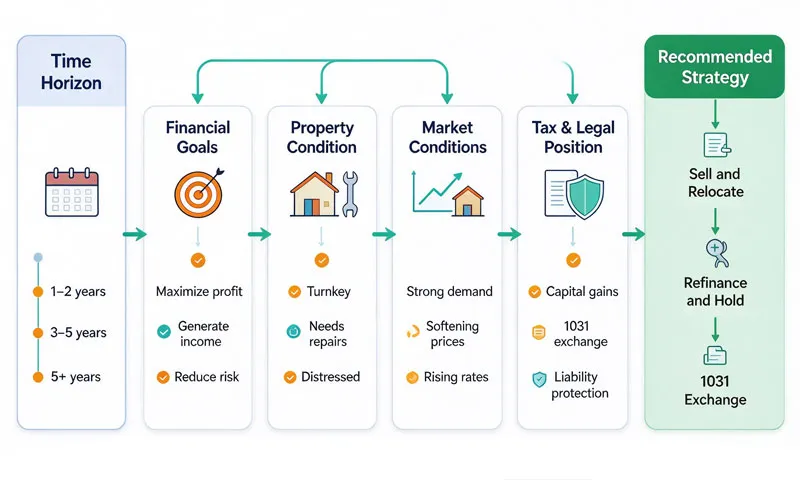
If your answers point in different directions, that’s a sign your deal doesn’t have a clean exit — reconsider before you buy.
9 Real Estate Exit Strategies, Compared
1. Buy and Hold for Rental Income
You keep the property, rent it out, and collect monthly cash flow while it appreciates. This works best in landlord-friendly markets with stable rent demand.
Tax note: Rental owners can deduct depreciation annually, but that deduction gets “recaptured” and taxed when you eventually sell. Plan for it — don’t get surprised by it.
2. Sale to Another Investor
Investor buyers close faster and negotiate with less emotion than retail buyers. The tradeoff: they’re sophisticated, and they’ll price in every flaw they find.
3. Owner / Seller Financing
You act as the lender. The buyer pays you directly, in installments, with interest.
Compliance alert: Seller financing on residential property is regulated under the Dodd-Frank Act and the SAFE Act. If you finance more than a handful of properties a year, you may need to work through a licensed loan originator. This isn’t optional paperwork — skipping it can void your note.
Seller financing compliance rules
4. 1031 Exchange
You sell one investment property and reinvest the proceeds into a “like-kind” property, deferring capital gains tax.
The two deadlines that matter:
- 45 days to identify a replacement property after your sale closes.
- 180 days to close on that replacement property.
Miss either one, and the exchange fails — you owe the tax you were trying to defer. This isn’t a strategy to attempt without a qualified intermediary.
5. REIT Conversion
Instead of managing property directly, you roll proceeds into a Real Estate Investment Trust. You trade control for liquidity — REIT shares trade like stocks, and professionals handle acquisition and management.
6. Wholesaling
You put a property under contract at a discount, then assign that contract to another investor for a fee. No renovation, minimal capital, fast turnaround. Some states require a real estate license to wholesale regularly — check before you scale this.
7. Fix-and-Flip
You renovate fully and resell at retail value. Works when your all-in cost leaves 10–15%+ of after-repair value as margin.
Tax note: Hold the property under a year, and profit is typically taxed as ordinary income — not the lower long-term capital gains rate. That gap alone can be the difference between a good flip and a break-even one.
8. Cash-Out Refinance and Hold (BRRRR)
Buy, renovate, rent, then refinance to pull your capital back out while keeping the asset. Works best when you have financing lined up before you buy — appraisal risk is the main failure point.
9. Convert to Residential Use
Repurposing commercial space into residential units can unlock value in the right market, but it lives or dies on local zoning approval. Run a feasibility study before you assume this is viable.
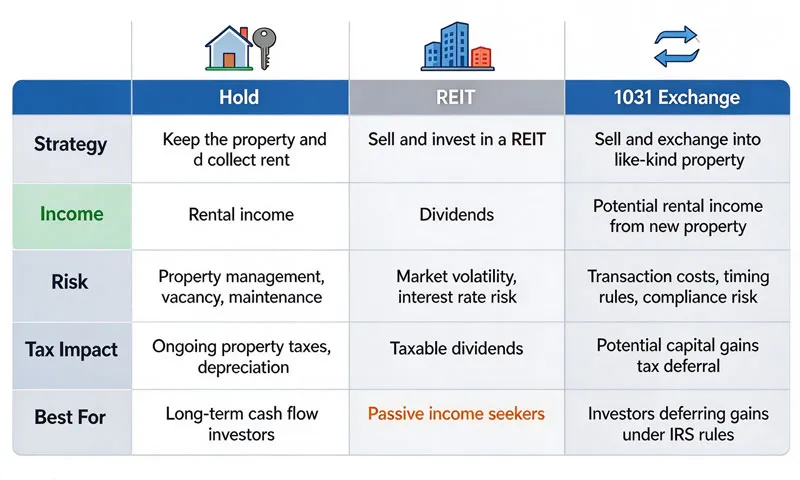
Exit Strategy Comparison: Hold vs. REIT vs. 1031 Exchange
| Factor | Direct Hold | REIT | 1031 Exchange |
|---|---|---|---|
| Liquidity | Low | High | Low |
| Minimum capital | High | Low | High |
| Tax treatment | Depreciation + recapture on sale | Dividends taxed as income | Gains deferred, not eliminated |
| Management involvement | Hands-on | None | Hands-on (new property) |
| Typical timeline | Years | Immediate (tradable) | 180-day window |
Case Study: One Property, Three Exits
Purchase price: $100,000. ARV after renovation: $200,000.
- Wholesale: Assign contract for $115,000 → roughly $15,000 profit, no tax deferral options, taxed as ordinary income.
- Flip: $155,000 all-in, sells for $200,000 → ~$30,000 profit before tax, but taxed at ordinary rates if held under a year.
- Buy and hold, then 1031 into a larger asset: No immediate tax bill, but capital stays illiquid and you take on a new mortgage.
Same property. Three very different after-tax outcomes. The “best” one depends entirely on what you need the money for and when.
Capital gains tax on investment property
Mistakes That Cost Investors the Most
- Only having one exit. If your single plan falls apart, you have no leverage in negotiation.
- Ignoring soft costs. Insurance, holding interest, and closing fees quietly erase margin.
- Underestimating the 1031 clock. Investors lose deferrals every year by missing the 45-day window.
- Tiny down payments on seller-financed deals. A buyer with nothing at stake has nothing to lose by walking away.
FAQ
What’s the best exit strategy for a first-time investor?
Wholesaling requires the least capital and the shortest learning curve, but buy-and-hold offers more predictable long-term returns if you can carry the mortgage.
How long do I have to complete a 1031 exchange?
45 days to identify a replacement property, 180 days total to close — both counted from your original sale date.
Do I pay capital gains tax if I reinvest through a 1031 exchange?
The tax is deferred, not eliminated. You’ll owe it eventually unless you keep exchanging or hold until death, when heirs may receive a stepped-up basis.
Is seller financing legal in every state?
Yes, but it’s regulated federally under Dodd-Frank and the SAFE Act. Frequent seller-financers may need a licensed loan originator involved.
The Bottom Line
Your exit strategy isn’t a footnote — it’s the plan that determines whether your investment actually pays off. Decide it before you buy, run the tax math honestly, and always have a backup.
Disclaimer: This article is for informational purposes only and does not constitute investment, tax, or legal advice. Real estate exit strategies carry financial and regulatory risk that varies by state and individual circumstances. Consult a licensed CPA, tax attorney, or real estate professional before making investment decisions.