

You open your paycheck and see “OASDI” quietly taking 6.2% of your earnings. What is it — and where does that money actually go? OASDI tax meaning comes down to this: it funds Social Security, the program that supports millions of Americans in retirement, after a disability, or following a family member’s death. This guide covers the 2025 rates, who pays, who’s exempt, and exactly how the math works.
Key Takeaways
- OASDI stands for Old-Age, Survivors, and Disability Insurance — the formal name for Social Security tax
- Employees pay 6.2%; employers match it; self-employed workers pay the full 12.4%
- The 2025 wage base limit is $176,100 — earnings above that aren’t taxed
- Three benefit types: retirement income, survivor payments, and disability support
- Some visa holders, clergy, and government employees may qualify for an exemption
- Overpaying OASDI (e.g., working two jobs) may entitle you to a refund at tax time
What Does OASDI Stand For?
OASDI stands for Old-Age, Survivors, and Disability Insurance. It’s the official government term for what most people simply call Social Security tax.
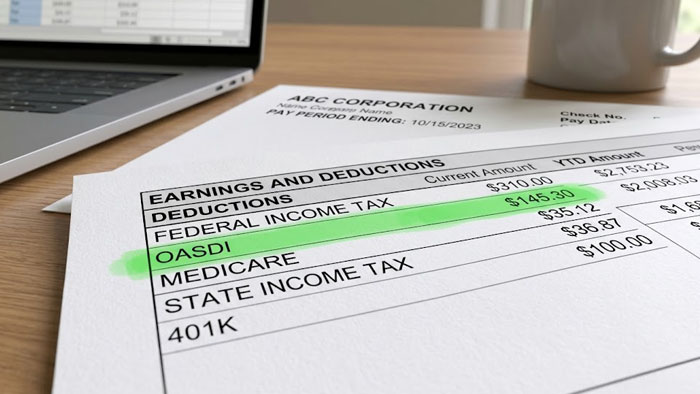
If your pay stub says “OASDI,” “Social Security,” or “FICA-SS,” they all refer to the same deduction.
One important distinction: OASDI is not the same as Supplemental Security Income (SSI). SSI is a separate, needs-based program funded through general tax revenue — not payroll taxes. You can qualify for both programs, but they operate independently.
OASDI is also separate from Medicare tax, though both fall under the FICA (Federal Insurance Contributions Act) umbrella.
OASDI vs. Medicare: A Quick Comparison
| OASDI (Social Security) | Medicare | |
|---|---|---|
| 2025 Employee Rate | 6.2% | 1.45% |
| 2025 Wage Cap | $176,100 | No cap |
| What It Funds | Retirement, survivors, disability | Hospital & medical insurance |
| Self-Employed Rate | 12.4% | 2.9% |
| High-Earner Surcharge | None | +0.9% above $200K |
What Is OASDI Tax on Your Paycheck?
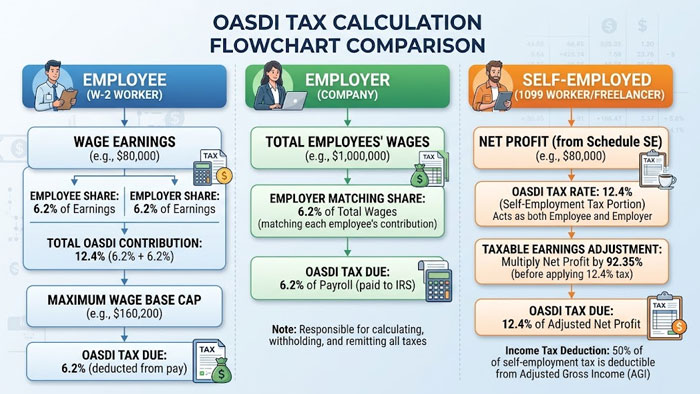
Every time you get paid, your employer withholds 6.2% of your gross wages for OASDI — automatically, before you see a cent.
Here’s a simple example:
- Monthly gross salary: $5,000
- OASDI withheld (6.2%): $310
- Your employer also pays: $310 (matching contribution)
- Total sent to SSA: $620
That $620 doesn’t sit in an account with your name on it. It goes into two Social Security trust funds that pay current beneficiaries — with the understanding that future workers will fund your benefits when the time comes.
One thing many employees miss: bonuses and commissions are also subject to OASDI, as long as your year-to-date earnings haven’t crossed the $176,100 wage base limit.
How FICA taxes affect your total compensation package
What Does OASDI Tax Fund?
Your contributions support three types of Social Security benefits.
Retirement Benefits
To qualify, you need at least 40 work credits — roughly 10 years of employment. In 2025, one credit equals $1,810 in wages, and you can earn up to four credits per year.
You can start collecting as early as age 62, but your monthly benefit will be permanently reduced. Wait until your full retirement age (66–67, depending on birth year), and you receive 100% of your earned benefit. Delay until 70, and your benefit grows by roughly 8% per year.
📊 According to the SSA, the average monthly retirement benefit in 2024 was approximately $1,907.
SSA official retirement benefits overview
Survivor Benefits
When a worker dies, eligible family members may receive monthly payments based on the deceased’s earnings record. Qualifying survivors include:
- Spouses (as young as 60, or 50 if disabled)
- Dependent children under 18
- Dependent parents aged 62 or older
The more the deceased contributed to Social Security, the higher the survivor benefit. An estimated 6 million children currently receive survivor benefits through OASDI.
Disability Benefits (SSDI)
Workers who can no longer work due to a serious medical condition can apply for Social Security Disability Insurance (SSDI). Eligibility depends on two tests:
- Recent Work Test — based on your age and how recently you worked
- Duration of Work Test — based on total years in the workforce
The average SSDI monthly benefit in 2024 was approximately $1,537, according to SSA data.
2025 OASDI Tax Rates and Wage Base Limit
Here are the official 2025 figures:
| 2024 | 2025 | |
|---|---|---|
| Employee Rate | 6.2% | 6.2% |
| Employer Rate | 6.2% | 6.2% |
| Wage Base Limit | $168,600 | $176,100 |
| Self-Employment Rate | 12.4% | 12.4% |
| Value of One Work Credit | $1,730 | $1,810 |
The wage base limit adjusts annually based on national wage trends. Once your earnings exceed $176,100 in a calendar year, OASDI withholding stops for the rest of that year — your employer stops matching too.
High earners notice this as a bump in take-home pay late in the year.
OASDI Tax for Self-Employed Workers
If you’re self-employed, freelance, or run your own business, the math hits harder.
Under the Self-Employment Contributions Act (SECA), you pay both the employee and employer portions — the full 12.4% on net earnings.
Example — Freelancer with $90,000 net income:
- OASDI tax owed: $90,000 × 12.4% = $11,160
- Deductible amount (50%): $5,580
- Net OASDI cost after deduction: $5,580
That 50% deduction is taken on your Form 1040 (not Schedule SE), and it reduces your adjusted gross income — not just your taxable income.
Tax Planning Note for Self-Employed Workers
One legal strategy worth discussing with a CPA: electing S-Corporation status. As an S-Corp owner, you pay yourself a reasonable salary (subject to OASDI) and take remaining profits as distributions (not subject to OASDI). Done correctly, this can meaningfully reduce your self-employment tax burden.
⚠️ This is not tax advice. Consult a licensed CPA or tax professional before restructuring your business for tax purposes.
Self-employed workers also pay OASDI quarterly via estimated tax payments, due in April, June, September, and January.
Who Is Exempt from OASDI Tax?
Most workers pay OASDI — but not everyone.
Religious Groups and Clergy
Members of certain religious orders and qualifying clergy can apply for an exemption using Form 4361. Opting out means forfeiting future Social Security benefits entirely.
Nonresident and Visa Holders
Workers on the following visa types are generally exempt:
| Visa Type | Worker Category |
|---|---|
| A-Visa | Foreign government employees |
| D-Visa | International ship/airline crew |
| F, J, M, Q-Visa | Students, researchers, exchange visitors |
| G-Visa | International organization employees |
Employers should verify visa status before running payroll — misclassification can trigger penalties.
State and Local Government Employees
If covered by a qualifying public pension plan that offers benefits at least as generous as Social Security, these workers may be exempt. They file Form 4029 to claim the exemption.
Self-Employed Earning Under $400
No OASDI tax is owed if your net self-employment income is below $400 for the year.
How to Calculate OASDI Tax: 3 Scenarios
Scenario A — Salaried employee, $60,000/year:
- $60,000 × 6.2% = $3,720/year ($310/month)
- Employer pays a matching $3,720
Scenario B — High earner, $220,000/year:
- Only the first $176,100 is taxable
- $176,100 × 6.2% = $10,918.20
- Earnings above $176,100 = $0 OASDI owed
Scenario C — Self-employed, $75,000 net income:
- $75,000 × 12.4% = $9,300
- Less 50% deduction: net cost = $4,650
OASDI Compliance for Employers
Employers have specific reporting and payment obligations.
- Form 941 — filed quarterly; reports withheld OASDI, Medicare, and federal income tax
- Form 944 — annual alternative for employers with $1,000 or less in annual employment tax liability
- W-2, Box 4 — reports total OASDI withheld per employee for the year
What Happens If You Don’t Pay?
The IRS takes payroll tax non-compliance seriously. Penalties include:
- Failure-to-deposit penalty: 2%–15% of unpaid tax, depending on how late the deposit is
- Trust Fund Recovery Penalty (TFRP): Owners and officers can be held personally liable for unpaid withheld taxes — this penalty pierces the corporate veil
- Criminal charges: Willful failure to pay can result in fines or imprisonment of up to five years
IRS Trust Fund Recovery Penalty explained
Frequently Asked Questions About OASDI Tax
Is OASDI the same as Social Security tax?
Yes. OASDI is the official program name; “Social Security tax” is the common term. Both refer to the same 6.2% payroll deduction.
Can I opt out of OASDI tax?
Most workers cannot. Exemptions exist for specific groups — certain religious members, qualifying visa holders, and some government employees — but opting out means giving up future Social Security benefits.
What happens to my OASDI contributions if I die before retiring?
Your contributions don’t disappear. Your surviving spouse, children, or dependent parents may qualify for monthly survivor benefits based on your earnings record.
Can I get a refund if I overpaid OASDI?
Yes. If you worked multiple jobs and your combined wages exceeded $176,100, you may have had OASDI withheld beyond the annual cap. Claim the excess as a tax credit on Form 1040, Line 11.
Does OASDI tax apply to investment income?
No. OASDI applies only to earned income — wages, salaries, tips, and net self-employment income. Capital gains, dividends, and rental income are not subject to OASDI.
Will Social Security still exist when I retire?
The SSA’s 2024 Trustees Report projects the combined trust funds can pay full benefits until approximately 2035, after which incoming tax revenue could cover around 83% of scheduled benefits — without any policy changes. Congress has historically acted to shore up the program before insolvency.
Disclaimer
This article is for informational purposes only and does not constitute tax, legal, or financial advice. Tax rates, thresholds, and regulations are subject to change. Always consult a qualified and licensed tax professional or CPA for guidance specific to your personal or business situation.