

You’re wondering whether to pay off student loan debt or buy a house — and honestly, most articles won’t give you a straight answer. Here’s the framework lenders actually use, so you can stop guessing and start planning.

Why This Isn’t a Simple Either/Or Decision
Forget the framing you’ve seen elsewhere. The real question isn’t which goal wins. It’s how much you can put toward each one, and in what order, without wrecking your monthly budget.
Two numbers matter more than your feelings about debt: your debt-to-income ratio (DTI) and your emergency fund size. Everything else — interest rates, timelines, career plans — feeds into those two levers.
Quick self-check before you read further:
- Is your DTI above 43%? Fix that first.
- Do you have less than 3 months of expenses saved? Build that before a down payment.
- Are your student loans federal with income-driven repayment? Your math changes — see the FHA section below.
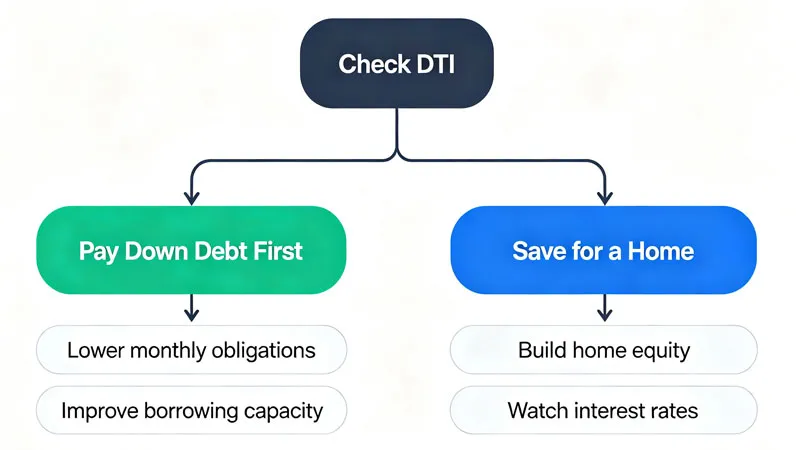
Student Loan Interest vs. Home Equity: The Real Math
Federal student loan rates for 2025-26 undergraduate Direct loans sit at 6.39%, while PLUS loans run higher. [federal student loan interest rates]. Compare that to national home price appreciation, which has averaged roughly 4-5% annually over the past decade according to the Federal Housing Finance Agency.
Here’s the uncomfortable truth: if your loan rate beats expected home appreciation, paying down debt wins mathematically. If it doesn’t, every year you delay buying costs you in lost equity growth.
Student Loans vs. Mortgage Debt: Side-by-Side
| Factor | Student Loans | Mortgage Debt |
|---|---|---|
| Typical rate (2026) | 6.4%–9%+ | 6.5%–7.2% |
| Tax deduction | Up to $2,500/yr (income capped) | Interest deductible if itemizing |
| Builds an asset? | No | Yes — home equity |
| Default consequence | Wage garnishment possible | Foreclosure |
Neither is “bad debt.” They just behave differently in your financial plan.
How Student Loans Actually Affect Mortgage Approval
Lenders don’t care about your loan balance directly. They care about your DTI — the percentage of gross monthly income going to debt payments.
The formula: Add up all monthly debt payments, divide by gross monthly income, multiply by 100.
Example: $4,500 monthly income, $450 student loan payment, $1,300 projected mortgage = 38.9% DTI.
Most conventional lenders cap DTI at 36-43%. [debt-to-income ratio calculator]
The FHA Rule Nobody Explains Well
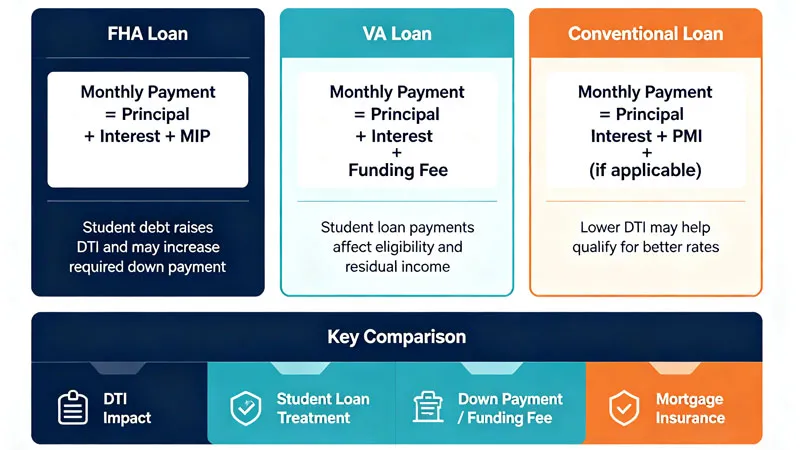
If you’re on an income-driven repayment (IDR) plan and your monthly payment shows as $0 or reduced, lenders can’t just ignore that. As of HUD’s current guidance, [FHA student loan DTI calculation], FHA lenders must count either your actual reported payment or, if none is reported, 0.5% of your outstanding loan balance as a placeholder debt.
VA loans are more lenient — deferred loans (12+ months out) can sometimes be excluded entirely. Conventional loans through Fannie Mae typically use the actual IDR payment, even if it’s $0. This distinction alone can swing your approval odds by thousands of dollars in qualifying income.
Building Both Goals at Once: A Practical Plan
You don’t have to choose. Most people who own homes with student debt do both, just not evenly.
Step 1 — Stabilize first. Get $1,000-1,500 in emergency savings before anything else. A financial emergency with zero cushion derails both goals faster than any interest rate.
Step 2 — Attack high-interest debt. If you’re carrying credit card debt at 20%+ alongside student loans at 6-7%, the credit card debt comes first, every time.
Step 3 — Split your extra cash. A common approach: 60% toward down payment savings, 40% toward extra student loan principal. Adjust based on which lever moves your timeline more.
Step 4 — Automate the down payment fund. Open a dedicated high-yield savings account and set a recurring transfer for the day after payday. [high-yield savings account guide]
The Retirement Question Most Guides Skip
Should you pause 401(k) contributions to buy sooner? Generally, no — not past your employer match. Skipping a 50% match to save an extra $200/month toward a down payment is a bad trade. Get the match, then split remaining funds between loans and savings.
Refinancing Before You Apply for a Mortgage
Refinancing can lower your monthly student loan payment and improve your DTI. But timing and trade-offs matter.
What you lose by refinancing federal loans into a private loan: Public Service Loan Forgiveness eligibility, income-driven repayment options, and federal deferment/forbearance protections. Once you refinance federal debt privately, there’s no going back.
Timing tip: Avoid applying for student loan refinancing and a mortgage in the same 30-day window. Both involve hard credit inquiries, and stacking them can temporarily dent your score right when you need it strongest.
Frequently Asked Questions
Is it bad to buy a house with student loan debt?
No. Lenders approve buyers with student debt every day, as long as your total DTI stays within their limits and your credit history is solid.
What DTI is too high to get approved with student loans?
Most conventional lenders draw the line around 43-45%. FHA and VA loans sometimes allow higher, up to 50% in strong cases.
Can I get approved with a $0 student loan payment under an IDR plan?
Sometimes. FHA lenders typically still count 0.5% of your loan balance as a placeholder payment, even if your actual bill is $0.
Should I pay off student loans before saving for a down payment?
Only if your loan interest rate is high relative to expected home appreciation, or your DTI is currently too high to qualify at all.
The Bottom Line
Run your own numbers before following generic advice. Check your DTI, confirm which loan program fits your situation, and decide how to split extra cash between debt and savings based on your actual interest rates — not assumptions.
Disclaimer: This article is for informational purposes only and does not constitute financial, tax, or legal advice. Mortgage and student loan rules vary by lender and change over time. Consult a licensed financial advisor, mortgage professional, or tax professional before making decisions based on your personal situation.