

Your 401(k) is maxed. Your Roth is phased out. Now someone’s pitching you a 7702 retirement plan as the fix. Before you sign anything, here’s what it actually is, what it costs, and who it really works for.
What Is a 7702 Retirement Plan, Really?
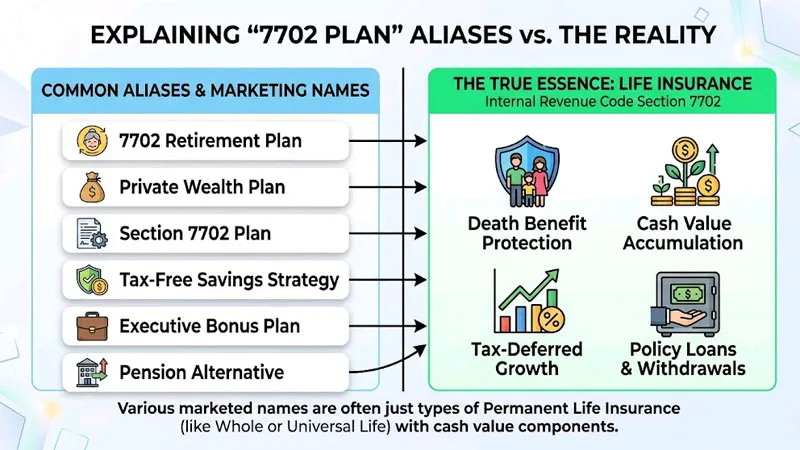
Here’s the first thing your agent probably didn’t say clearly: a 7702 plan isn’t a retirement account. It’s cash value life insurance. There’s no government agency behind it, no special account type at your bank. The name comes from Section 7702 of the tax code, which sets the rules for how life insurance gets taxed.
You’ll hear it called a 702(j) plan, a 770 account, a LIRP, or a “private retirement plan.” Same product, different sales script. Strip away the branding and you’re left with a permanent life insurance policy — usually Indexed Universal Life (IUL) — built to grow cash value alongside a death benefit.
Where the “7702” Name Actually Comes From
[Internal Revenue Code Section 7702] lays out two tests a policy must pass to get favorable tax treatment: the Cash Value Accumulation Test and the Guideline Premium and Corridor Test. Fail both, and the IRS reclassifies your policy as a Modified Endowment Contract. Loans become taxable. Early withdrawals get hit with a 10% penalty. This is the technical backbone that makes tax-free loans possible — and it’s why structuring matters more than most sales pitches let on.
Is a 7702 Retirement Plan a Scam?
No. But the reputation isn’t undeserved.
The product is real. Established carriers issue these policies every day. What’s not real is the framing some agents use — “secret retirement account,” “government-backed,” “tax loophole nobody talks about.” That language exists to obscure one fact: you’re buying life insurance, not a retirement plan.
Red Flags Worth Watching For
- The agent avoids the words “life insurance” for the first ten minutes
- No mention of surrender charges or mortality costs
- Promises of guaranteed double-digit returns
- Pressure to sign before you’ve seen a full policy illustration
- The agent can’t tell you whether the policy uses CVAT or GPT
If any of these show up, walk. A licensed professional explains the product plainly. Nobody has to dress up life insurance to make it worth considering.
How a 7702 Plan Actually Works
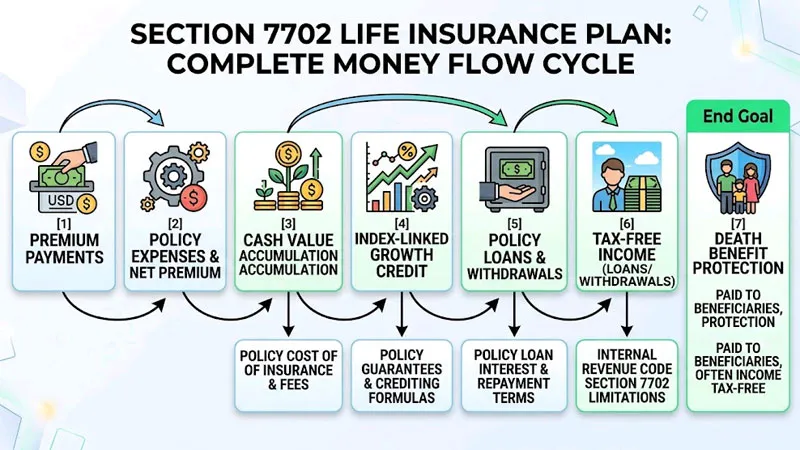
Premiums go in after tax. Part covers the cost of insurance. The rest builds cash value, credited with interest tied to a market index like the S&P 500 — capped on the upside, floored at 0% on the downside. You don’t invest directly in the market. You get a return tied to it, within limits set by the insurer.
Once cash value builds — usually seven to ten years in — you can borrow against it. Policy loans aren’t taxable income. You’re not required to repay them during your lifetime. Whatever’s outstanding gets deducted from the death benefit when you die.
Congress adjusted the minimum interest rate assumption under [Consolidated Appropriations Act Section 7702 rate changes], dropping it from 4% to 2%. That change let insurers design policies allowing higher premium contributions without tripping MEC status — a meaningful shift for anyone funding a policy aggressively.
The Real Cost of a 7702 Plan
This is where most explainers stop short.
Fees hit hardest in years one through ten. You’re paying mortality and expense charges, administrative fees, premium loads, and — if you cancel early — surrender charges that can run 10% or more of your cash value in the first decade. Ask for a full policy illustration showing guaranteed and non-guaranteed columns side by side. If an agent won’t provide one, that’s your answer.
A simplified example: a 35-year-old paying $20,000 a year for 20 years might see minimal net cash value in years one through five, meaningful growth by year ten, and real momentum by year twenty — but the exact numbers depend entirely on the carrier, the cap rate, and how the policy is structured. Treat any projection as an estimate, not a guarantee.
7702 Plan vs. 401(k) vs. Roth IRA
| Feature | 7702 Plan (IUL) | 401(k) | Roth IRA |
|---|---|---|---|
| Contribution limit | None (policy-based) | $23,500 (2025) | $7,000, income-capped |
| Tax on contributions | After-tax | Pre-tax | After-tax |
| Withdrawals | Tax-free via loans | Taxed as income | Tax-free |
| Early withdrawal penalty | None | 10% before 59½ | Earnings penalized |
| Required distributions | None | Starts at 73 | None |
| Income limits | None | None | Phases out at high income |
| Market risk | Floored, capped | Full exposure | Full exposure |
The gap a 7702 plan fills is narrow but real: unlimited, penalty-free, tax-free savings for people locked out of Roth contributions. It’s not a replacement for either account — it’s a third bucket.
7702 Plan vs. Other High-Income Strategies
Before committing premium dollars for a decade, compare it against the alternatives most high earners skip:
- Mega Backdoor Roth 401(k) — if your employer plan allows after-tax contributions, this often beats a 7702 plan on cost and simplicity
- Backdoor Roth IRA — a two-step conversion that sidesteps income limits entirely
- HSA — triple tax advantage if you’re on a high-deductible health plan, frequently overlooked
A reasonable order of operations: capture your full 401(k) match first, build an emergency fund, max the Backdoor Roth and HSA, then consider a 7702 plan with whatever capacity remains. Skipping straight to life insurance before exhausting cheaper, more liquid options is a common — and costly — mistake.
Mega Backdoor Roth 401(k) strategy guide
Who Should Consider a 7702 Retirement Plan
This fits people with a specific profile: household income above $150,000, both spouses’ retirement accounts already maxed, ten or more years until retirement, and steady cash flow that can absorb premiums without strain. Business owners with no employer plan often fall into this category too.
When to Walk Away
Skip it if you haven’t captured your full employer match, if you’re within ten years of retirement, if premiums would stretch your monthly budget, or if you need liquidity in the next five years. Surrender a policy early and the fees will outweigh whatever tax benefit you were chasing.
High-income tax diversification strategies
How to Choose the Right Policy and Advisor
Compare cap rate, participation rate, floor guarantee, and surrender period across at least three carriers before deciding. Ask directly: does this policy use CVAT or GPT? Is the illustrated rate guaranteed or projected? What’s the insurer’s [A.M. Best financial strength rating]?
That last question matters more than most buyers realize. If a carrier fails, your protection is limited to your state’s guaranty association coverage cap — typically $250,000 to $300,000 in cash value, varying by state. Nobody selling you this policy volunteers that number. Ask for it.
Verify your advisor holds an active insurance license through your state’s insurance department, and confirm whether they’re also a fiduciary. A commissioned agent and a fee-only fiduciary have different incentives — know which one you’re talking to.
Frequently Asked Questions
Is a 7702 plan the same as a 702(j) or 770 account?
Yes. All three describe the same product — cash value life insurance structured under IRC Section 7702. The name changes; the underlying policy doesn’t.
Can I lose money in a 7702 plan?
Market-linked losses are floored at 0%, but fees, surrender charges, and an early lapse can still erode your cash value. It’s not risk-free.
How long before I can access meaningful cash value?
Plan on seven to ten years minimum. Early withdrawals mostly cover fees, not growth.
What happens if my insurer goes bankrupt?
State guaranty associations provide backup coverage, but only up to a set cap — often $250,000–$300,000. Confirm your carrier’s financial strength rating before signing.
Do I still need this if I already max out my 401(k) and Roth options?
Only if you have leftover savings capacity and a ten-year-plus horizon. It’s a supplement, not a starting point.
Key Takeaways
- A 7702 plan is life insurance, not a retirement account — the tax benefits come from IRC Section 7702, not a special retirement vehicle
- Fees are steepest in the first decade; ask for a full illustration before committing
- Compare it against Mega Backdoor Roth and HSA options first — cheaper alternatives often exist
- Check your insurer’s financial strength rating and your state’s guaranty association cap before funding a policy
- Best suited for high earners with a decade-plus horizon and fully-funded traditional accounts already in place
Disclaimer: This article is for general informational purposes only and does not constitute investment, tax, or legal advice. Life insurance products carry fees, surrender charges, and carrier-specific terms that vary widely. Consult a licensed financial advisor, CPA, or insurance professional before making decisions based on your individual circumstances.