

Learning how to save money as a kid shapes financial habits that last a lifetime. Raising a child now costs over $300,000 through age 18. Most parents know they should start saving early — few know which account actually fits their goals. This guide covers both: the habits that build a saver, and the exact tools that hold the money.

Why Teaching Kids to Save Money Actually Matters
Money habits form earlier than most parents assume. Researchers at the University of Cambridge found that core financial behaviors are largely set by age 7 — well before most kids open a bank account. early financial behavior formation research
The financial stakes are real too. Raising a child to age 18 now averages north of $310,000, not counting college. That number alone justifies starting early, but the bigger payoff is behavioral: kids who practice saving as children carry the habit into adulthood, according to research from the FINRA Investor Education Foundation. [child financial literacy outcomes data]
This guide is built in two parts. First, the habits to teach at each age. Second, the actual accounts to hold the money — updated for 2026 tax rules.
Teaching Kids to Save Money by Age
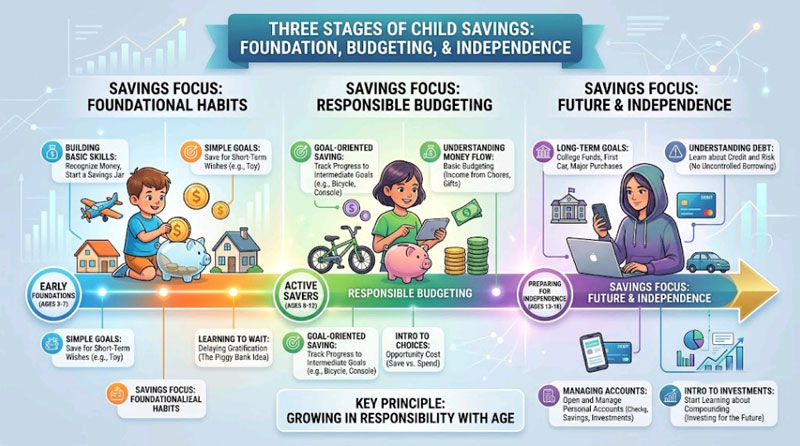
Ages 3–7: Introducing the Concept of Saving
Little kids can’t grasp interest rates. They can grasp a clear piggy bank filling up.
- Use a see-through jar so progress is visible.
- Set one small, concrete goal — a toy, not a vague amount.
- Practice the phrase “we’re saving for it” instead of buying on demand.
Delayed gratification is a learned skill, not an instinct. Child development specialists point to this exact age range as the window where patience habits take root.
Ages 8–12: Building Structured Habits
This is where saving gets real. Kids this age can handle an allowance and simple math.
The three-jar method still works better than anything more complicated:
- Save — for a goal weeks or months away
- Spend — for small purchases now
- Share — for giving or charity
This is also the right age to open a first kids’ savings account. A few things to check before you do:
- No minimum balance requirement
- No monthly maintenance fees
- FDIC insurance up to $250,000 per depositor
- A parent or guardian as joint account holder (required for minors)
The average weekly allowance for this age group runs roughly $1 per year of age, based on recent parenting surveys — so a 10-year-old might get around $10 a week. [age-appropriate allowance guide]
Ages 13–18: Preparing for Real Financial Independence
Teens are close to adulthood, and the accounts should reflect that.
- A first part-time job introduces payroll tax withholding — walk through their first paycheck together.
- Budgeting now covers real costs: prom, a car, college application fees.
- Credit conversations should start here, with a hard rule: only spend what you can pay off in full.
By this stage, the account matters as much as the habit. That’s where the next section comes in.
Where to Put Your Kid’s Savings: Comparing the Accounts
Picking the right account depends on one question: what is this money actually for?
| Account Type | Who Controls It | Tax Treatment | Liquidity | Best For | 2026 Contribution Limit |
|---|---|---|---|---|---|
| Kids’ Savings Account | Parent (joint) | Interest taxed above kiddie tax threshold | High | Everyday saving habits | None |
| CD | Parent (custodial) | Interest taxed | Low (fixed term) | Short-term, guaranteed rate | None |
| Custodial (UTMA/UGMA) | Parent until transfer age | Kiddie tax rules apply | Medium | Flexible gifts, general savings | Gift tax exclusion applies |
| 529 Plan | Parent (account owner) | Tax-deferred growth, tax-free for education | Low | College costs | Up to $19,000/$38,000 gift-tax-free (2026) |
| Custodial Roth IRA | Parent until transfer age | Tax-free growth | Low until retirement | Long-term compounding | Limited to earned income |
| Trust | Trustee-defined | Varies by structure | Very low | Complex estates, special needs | No standard limit |
Kids’ Savings Accounts
The simplest starting point. Most banks and credit unions let a parent open one jointly with a minor of any age. Deposits are easy, and FDIC coverage protects the balance. The tradeoff: interest rates on standard kids’ accounts often lag behind high-yield options for adults.
Custodial Accounts (UTMA/UGMA)
A custodial account lets you invest on your child’s behalf — stocks, bonds, mutual funds. The money legally belongs to the child the moment you deposit it. That’s the catch: you can’t pull it back for yourself, and control transfers to your child at 18 to 25, depending on state law.
For 2026, contributions up to $19,000 per parent ($38,000 for married couples filing jointly) avoid triggering federal gift tax. Go above that and it counts against the lifetime exclusion — currently around $14 million, so most families never hit it in practice. [2026 federal gift tax exclusion figures]
529 Plans
Built for education, and hard to beat for that purpose. Growth is tax-deferred, and qualified withdrawals — tuition, room and board, even some K-12 costs — come out federal-tax-free. As of 2024, unused 529 funds can roll into a Roth IRA for the beneficiary, up to $35,000 lifetime, provided the account has been open at least 15 years.
One detail parents miss: 529s owned by a parent count far less against financial aid eligibility than accounts owned by the student directly.
Custodial Roth IRA
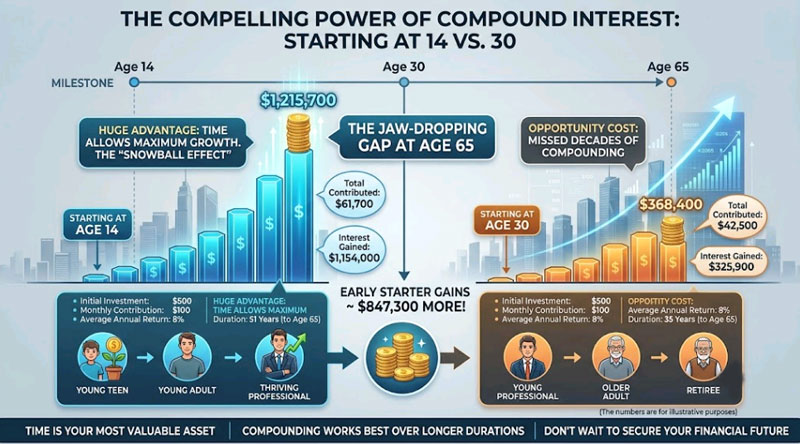
Counterintuitive, but powerful. If your child has earned income — babysitting, a summer job, freelance work — they can contribute to a Roth IRA. The money grows tax-free, and because a teenager’s tax rate is usually near zero, this locks in decades of compounding without ever paying tax on the gains.
Trusts
Trusts make sense for larger estates or special-needs planning, not everyday saving. Setup typically runs $1,000 or more, so they’re worth it only when the flexibility or asset protection justifies the cost.
Which Account Fits Your Family?
- Goal is education → 529 plan
- Goal is a flexible gift or general savings → Custodial account
- Goal is long-term, tax-free growth and your child has earned income → Custodial Roth IRA
- Goal is simple habit-building for a young child → Kids’ savings account
Common Mistakes Parents Make
- Waiting too long to start. Even $20 a month compounds meaningfully over a decade.
- Ignoring gift and kiddie tax rules. Unearned income above $2,700 gets taxed at the parent’s rate in 2026.
- Putting everything in one account type. A savings account for habits and a 529 for education can coexist.
- Leaving the child out of the process. Kids who track their own balance retain the lesson better than kids who don’t.
FAQ: How to Save Money as a Kid
At what age can a child open their own savings account?
Most banks let a parent open a joint account for a child of any age. Kids typically can’t open one solo until 18, though some banks allow teens to co-manage an account starting around 13.
Can I withdraw money from my child’s custodial account?
Only if the withdrawal directly benefits the child. Custodial account funds are an irrevocable gift — you can’t use them for yourself or transfer them elsewhere.
Is a 529 plan or custodial account better for financial aid?
A 529 owned by a parent typically hurts aid eligibility less than a custodial account, since student-owned assets are weighted more heavily in aid formulas.
Do kids pay taxes on savings account interest?
Yes, above certain thresholds. In 2026, the first $1,350 of a child’s unearned income is untaxed, the next $1,350 is taxed at the child’s rate, and anything above $2,700 is taxed at the parent’s rate.
How much allowance should I give my child to encourage saving?
A common rule of thumb is $1 per week for every year of age, though the right amount depends on what the allowance is meant to cover.
Disclaimer: This article is for educational purposes only and does not constitute financial, tax, or legal advice. Tax rules and contribution limits change annually — consult a licensed financial advisor or tax professional before opening an account or making contribution decisions for your child.