

An in-service distribution lets you pull money from your 401(k) or 403(b) while you’re still working for the plan sponsor. That sounds simple. The tax rules, age limits, and plan-specific fine print are not. This guide walks through eligibility, penalties, rollover options, and the mistakes that cost people thousands.
What Is an In-Service Distribution?
An in-service distribution is a withdrawal you take from an employer-sponsored retirement plan while you’re still employed there. It’s different from a regular distribution, which only happens after you leave your job or retire.
It’s also different from an in-service rollover, which moves funds into a separate account like an IRA instead of paying them out to you directly.
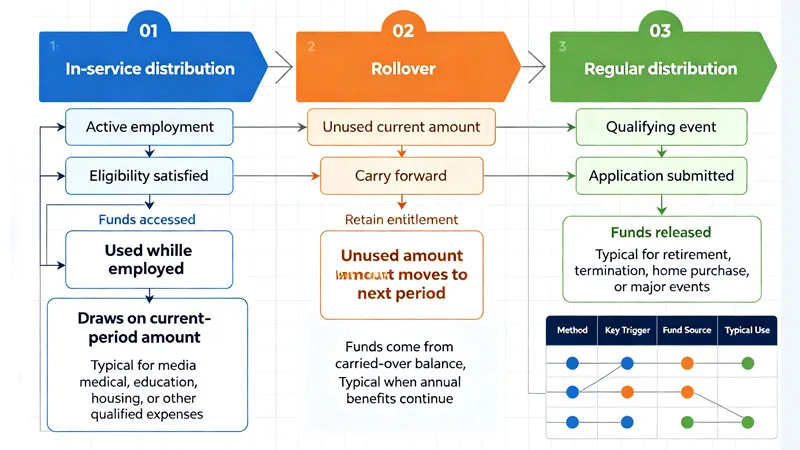
| Type | When Available | Tax Treatment | Penalty Risk |
|---|---|---|---|
| In-Service Distribution | While employed, if plan allows | Taxed as ordinary income | 10% if under 59½ |
| In-Service Rollover | While employed, moved to IRA/other plan | No immediate tax | None if done correctly |
| Regular Distribution | After termination or retirement | Taxed as ordinary income | 10% if under 59½ |
Which Plans Allow This?
401(k), 403(b), and TSP plans can offer in-service distributions, but they don’t have to. ESOPs handle this differently — [ESOP in-service distribution rules] covers those distinctions in depth. Your plan document is the only source that tells you what your employer actually permits.
Am I Eligible? Age Rules You Need to Know
Here’s where most people get confused, and it’s the biggest gap in most articles on this topic: there are three different “retirement ages,” and they don’t mean the same thing.
- 59½ — the age the IRS uses to waive the 10% early withdrawal penalty on most distributions.
- Your plan’s stated retirement age — set by your employer, often 55, 62, or 65. This determines when your plan allows a distribution at all.
- Social Security full retirement age — 66 to 67 depending on your birth year. This has nothing to do with your 401(k) rules.
Mixing these up leads people to assume they’re penalty-free when they’re not. Check your Summary Plan Description (SPD) before you assume anything.
Social Security full retirement age chart
Vesting Still Matters
Your own contributions are always 100% yours. Employer contributions may not be.
- Graded vesting — you earn a percentage each year (say, 20% annually over five years).
- Cliff vesting — you own 0% until a set date, then 100% all at once.
- Immediate vesting — you own employer contributions the moment they land.
According to Vanguard’s How America Saves report, a large share of 401(k) plans now use immediate or short graded vesting schedules, a shift from a decade ago. [vesting schedule trends data]
In-Service Distribution vs. Hardship Withdrawal vs. 401(k) Loan
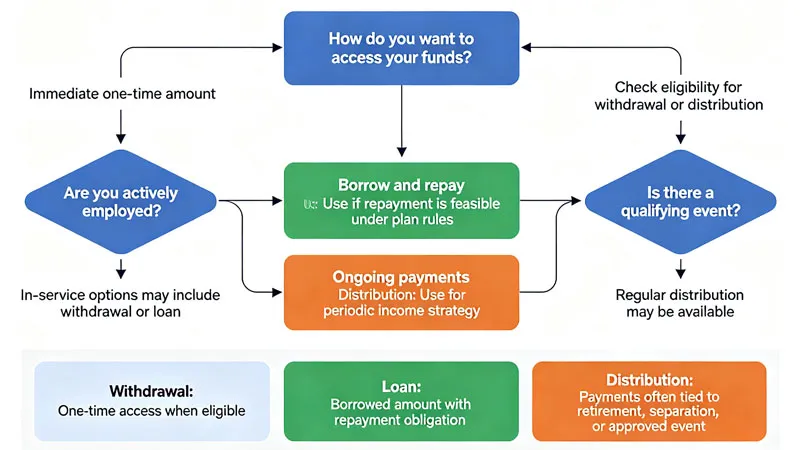
People often search for “in-service distribution” when what they actually need is one of its cousins. Here’s how they stack up.
| Feature | In-Service Distribution | Hardship Withdrawal | 401(k) Loan |
|---|---|---|---|
| Must be repaid? | No | No | Yes |
| Early withdrawal penalty | Yes, if under 59½ | Waived, but still taxed | No |
| Impact on retirement balance | Permanent | Permanent | Temporary |
| Approval process | Depends on plan | Requires proof of hardship | Usually straightforward |
IRS-Approved Hardship Reasons
A hardship withdrawal skips the 10% penalty (not the income tax) if it covers:
- Tuition and education costs for the next 12 months
- Unreimbursed medical expenses above a set income threshold
- Up to $10,000 for a first home purchase
- Funeral costs for immediate family
- Repairs to your primary residence after casualty loss
- Costs tied to domestic abuse, added under SECURE 2.0
That last one is new. Older guides built before 2023 won’t mention it. [SECURE 2.0 Act hardship provisions]
The Tax Bill Nobody Warns You About
The 10% Penalty
If you’re under 59½ and don’t qualify for an exception, you’ll owe an extra 10% on top of regular income tax. Death and permanent disability are the main exceptions outside the hardship list.
The 20% Withholding Rule
Here’s a detail most guides skip: mandatory 20% federal withholding only applies to eligible rollover distributions — not every type of in-service withdrawal. If your distribution doesn’t qualify as a rollover-eligible payment, different withholding rules apply. Ask your plan administrator which category your withdrawal falls into before you file.
State Taxes
Nine states don’t tax retirement income at all, including 401(k) distributions: Alaska, Florida, Nevada, South Dakota, Tennessee, Texas, Washington, Wyoming, and New Hampshire. Everywhere else, expect a state tax bill on top of federal.
Example: Sarah, 62, withdraws $20,000 from her 401(k). She’s past 59½, so no penalty applies. Her plan withholds 20% ($4,000) for federal tax. Her state (California) adds roughly 9.3% at her bracket, another $1,860. She nets closer to $14,140 — not $20,000.
That math surprises a lot of people. Run your own numbers before you commit.
What Is an In-Service Rollover, and Should You Do One?
An in-service rollover moves your balance into an IRA while you’re still employed, instead of paying it out to you. Most people do this for investment flexibility — IRAs typically offer far more fund choices than a single employer plan.
Costs to Check First
- Transfer fees: usually $20–$75, charged by the outgoing plan
- Fund expense ratios: can run higher inside an IRA than in a large employer plan with institutional pricing
- Advisory fees: if you’re hiring someone to manage the new account, ask for the fee upfront in writing
None of these costs are dealbreakers on their own. Stacked together, they can quietly eat into returns over 20 years. [401k rollover cost comparison]
Common Mistakes We See Constantly
In our work with plan participants, three mistakes come up again and again:
- Withdrawing before checking vesting status — leaving money on the table that hasn’t fully vested yet.
- Assuming Social Security retirement age applies to their 401(k) — it doesn’t.
- Skipping a tax professional before a large withdrawal — then getting hit with an unexpected bill in April.
None of these are complicated to avoid. They just require checking the plan document and running the numbers before, not after, you withdraw.
Frequently Asked Questions
Can I take an in-service distribution and keep contributing to my 401(k)?
Yes, in most plans. The withdrawal and your ongoing payroll contributions are separate. Confirm with your plan administrator, since a few plans restrict new contributions for a short period after a withdrawal.
Are Roth in-service withdrawals taxable?
Your original Roth contributions come out tax-free. Any investment growth is taxed if your account hasn’t met the five-year holding requirement or you’re under 59½.
What happens to my in-service distribution if I leave my employer later?
Nothing changes retroactively. The distribution was already taxed (and penalized, if applicable) at the time you took it. Leaving the company afterward doesn’t reverse that.
Do all employers allow in-service withdrawals?
No. It’s an optional plan feature. Some employers only allow in-service rollovers, not direct cash distributions. Check your SPD or ask HR directly.
Before You Withdraw, Talk to Someone Who Knows Your Full Picture
An in-service distribution can solve a real cash need or open better investment options. It can also trigger taxes and penalties you didn’t plan for. If you’re weighing this decision, a quick conversation with a fiduciary advisor can save you from an expensive mistake.
Disclaimer: This article is for general informational purposes only and does not constitute financial, tax, or legal advice. Rules vary by plan and by individual circumstances. Consult a licensed financial advisor, CPA, or tax professional before making any decisions about your retirement account.