

If you’ve ever opened a credit union account and noticed the word “dividend” instead of “interest,” you’re not alone in wondering what that actually means — and whether it matters. A deposit dividend is how credit unions share profits with their members. It looks like interest, but it’s legally and structurally different. This guide breaks down exactly how it works, how it’s taxed, how safe your money is, and how to earn more of it.
What Is a Deposit Dividend — And Why It’s Not Just “Interest”
A deposit dividend is a payment made by a credit union to its members, based on the institution’s profits. Banks pay interest — a contractual cost of borrowing your money. Credit unions pay dividends — a share of what the cooperative earned.
This distinction matters more than most people realize.
Credit unions are member-owned, not-for-profit cooperatives. When the institution earns money (primarily by issuing loans), it distributes a portion of those profits back to members who hold deposit accounts. That distribution is called a deposit dividend.
Banks, on the other hand, are for-profit businesses. The “interest” they pay you is simply the cost of using your funds — calculated to be as low as the market allows.
Credit Union Dividend vs. Bank Interest: Side-by-Side
| Dimension | Credit Union Dividend | Bank Interest |
|---|---|---|
| Legal structure | Profit distribution | Contract obligation |
| Regulated by | NCUA | FDIC |
| Tax form issued | 1099-INT | 1099-INT |
| Rate set by | Board of directors | Market pricing |
| Deposit insurance | Up to $250,000 | Up to $250,000 |
| Guaranteed? | No — depends on profit | Yes — per agreement |
NCUA official deposit insurance explainer
Both receive the same 1099-INT tax form, but the underlying mechanics are fundamentally different.
How a Dividend Savings Account Actually Works
The Calculation Behind Your Monthly Payout
Credit unions typically calculate dividends daily and credit them monthly. Here’s what that looks like with real numbers.
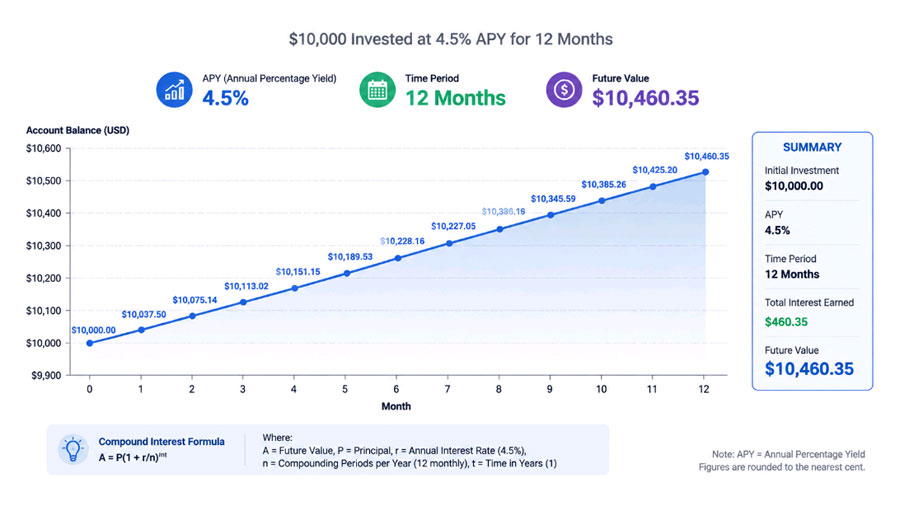
Example: $10,000 deposit, 4.50% APY, daily compounding
- Daily periodic rate: 4.50% ÷ 365 = 0.01233%
- Day 1 earnings: $10,000 × 0.0001233 = $1.23
- Month 1 payout (30 days): ≈ $36.99
- Month 6 balance: ≈ $10,225
- Month 12 balance: ≈ $10,460
The compounding effect is modest in year one — but accelerates meaningfully if you leave it untouched.
The 4 Key Dates That Determine When You Get Paid
| Date | What It Means for You |
|---|---|
| Declaration date | Board announces dividend rate |
| Ex-dividend date | Must hold account before this date to qualify |
| Record date | Credit union confirms eligible members |
| Payment date | Dividend appears in your account |
For most savings accounts, this cycle runs monthly automatically. You don’t need to do anything — as long as you meet the minimum balance requirement.
⚠️ Watch this: If your balance drops below the minimum (often $500) even for a single day in the period, many credit unions will withhold that month’s dividend entirely. Set a balance alert to avoid this.
Types of Deposit Dividend Accounts — Matched to Your Goal
Not all dividend accounts are built the same. Here’s how to pick the right one.
High-Yield Savings Account (HYSA)
Best for: Emergency fund, short-term savings
- Dividends paid monthly, calculated daily
- Variable rate — changes with market conditions
- High liquidity: withdraw anytime without penalty
- Watch for: introductory “teaser” rates that reset after 3–6 months
Money Market Dividend Account
Best for: Larger balances with occasional access needs
- Higher minimum balance (often $2,500–$10,000)
- Slightly better rates than standard HYSA
- May include check-writing privileges
Certificate of Deposit (CD)
Best for: Savings with a known end date (down payment, vacation fund)
- Fixed rate locked at opening — you won’t benefit if rates rise, but you’re protected if they fall
- Early withdrawal penalty: typically 90–180 days of dividends
- At a credit union, often called a “share certificate”
Dividend-Bearing Checking Account
Best for: Everyday spenders who want passive returns
- Usually requires 10–15 debit transactions per month to qualify
- Rates are lower, but you earn while spending
- Often overlooked — and rarely covered by competitors
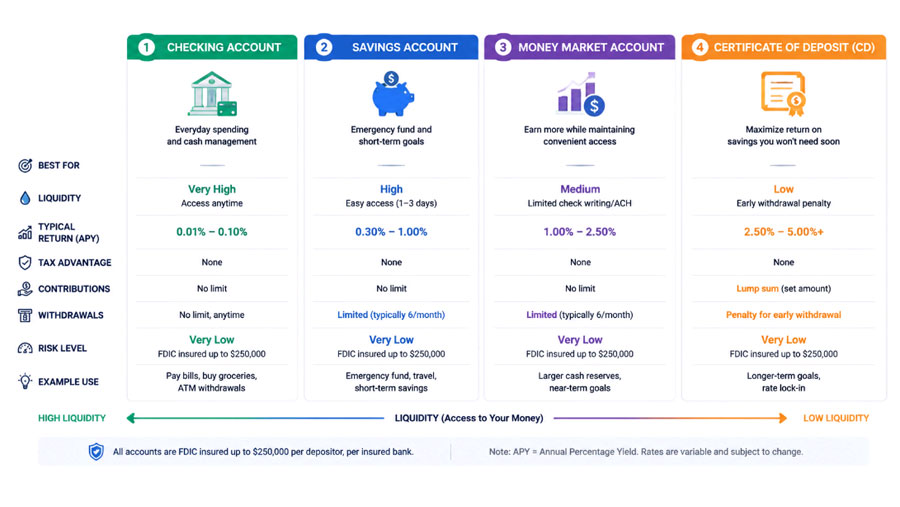
Account Type Comparison
| Account | Liquidity | Typical APY Range | Best For |
|---|---|---|---|
| HYSA | High | 3.5%–5.0% | Emergency fund |
| Money Market | Medium | 3.8%–5.2% | Mid-size savings |
| CD (12-month) | Low | 4.0%–5.3% | Goal-based saving |
| Dividend Checking | High | 2.0%–6.0%* | Daily transactions |
*High-rate checking often requires qualifying activity each month.
compare the best high-yield savings accounts available today
Deposit Dividend Tax Rules — What the IRS Requires
This is where most articles go silent. Don’t let tax season catch you off guard.
Yes, Deposit Dividends Are Taxable
Despite the word “dividend,” deposit dividends from credit unions are taxed as ordinary income — not at the lower qualified dividend rate that applies to stock dividends. This is a common and costly misconception.
Your credit union will send a 1099-INT form if you earn $10 or more in dividends during the tax year. You report this on your federal return under interest income.
Tax Rate Comparison: Deposit Dividend vs. Stock Dividend
| Income Type | Tax Category | Federal Rate |
|---|---|---|
| Credit union deposit dividend | Ordinary income | 10%–37% |
| Qualified stock dividend | Preferential rate | 0%–20% |
| Non-qualified stock dividend | Ordinary income | 10%–37% |
IRS guidance on interest and dividend income reporting
State Taxes Add Another Layer
Seven states have no income tax (including Texas and Florida), which means your deposit dividends are effectively tax-free at the state level. California residents, at the other end, face up to 13.3% in state income tax on top of federal rates.
Disclaimer note: Tax rules vary by individual situation. Consult a licensed CPA or tax advisor before making decisions based on projected after-tax dividend income.
Is Your Money Safe? NCUA Insurance, Explained
Before worrying about yield, make sure your deposits are protected.
NCUA vs. FDIC: The Key Difference
Both provide up to $250,000 in deposit insurance per account ownership category. For most savers, the protection level is identical. The difference is the regulator:
- FDIC covers banks
- NCUA covers federally insured credit unions
Joint accounts get up to $500,000 in coverage ($250,000 per co-owner). IRA accounts at a credit union receive a separate $250,000 of coverage on top of regular accounts.
How to Verify Your Credit Union Is NCUA-Insured
- Look for the official NCUA logo on the credit union’s website or branch
- Use the NCUA Credit Union Locator at mycreditunion.gov
- Check the credit union’s charter documents
Not all credit unions are federally insured. Some are state-chartered with private insurance. These are legitimate, but the coverage terms differ — always verify before depositing significant funds.
How to Maximize Your Deposit Dividend Returns
The 5-Year Compounding Effect (Real Numbers)
| Starting Balance | APY | Year 1 | Year 3 | Year 5 |
|---|---|---|---|---|
| $20,000 | 3.5% | $20,712 | $22,228 | $23,853 |
| $20,000 | 4.5% | $20,918 | $22,853 | $24,931 |
| $20,000 | 5.0% | $21,025 | $23,153 | $25,526 |
The difference between 3.5% and 5.0% over five years: $1,673 on a $20,000 deposit — without doing anything extra.
Three Practical Moves to Earn More
1. Use a CD ladder.
Split your savings into multiple CDs with staggered maturity dates (3, 6, 12, 24 months). As each CD matures, reinvest at current rates. This gives you liquidity without sacrificing yield.
2. Automate a buffer above the minimum balance.
Set a recurring transfer to keep your account $200–$300 above the minimum. One unexpected expense won’t cost you a month’s dividends.
3. Don’t let dividends sit idle.
If you don’t need the income now, reinvest it. Moving monthly dividends into a brokerage account to buy low-cost index funds is a simple way to compound across asset classes.
Deposit Dividend vs. Stock Dividend: Two Very Different Things
If you’ve landed here thinking about stock dividends, this table will clarify things quickly.
| Factor | Deposit Dividend | Stock Dividend |
|---|---|---|
| Principal at risk? | No (NCUA insured) | Yes |
| Guaranteed? | No (profit-dependent) | No |
| Tax rate | Ordinary income | Qualified or ordinary |
| Liquidity | High (savings accounts) | Market-dependent |
| Return driver | Institutional profit | Company earnings/policy |
| Volatility | Very low | Moderate to high |
Deposit dividends are a capital preservation tool. Stock dividends are a return-generation tool. Most people building long-term wealth need both — but confusing them leads to bad allocation decisions.
FAQ: What People Actually Ask About Deposit Dividends
Q: Is a deposit dividend the same as interest on a savings account?
unctionally similar, but not identical. Banks pay interest as a contractual obligation. Credit unions pay dividends as a profit distribution. Both show up on a 1099-INT and are taxed the same way.
Q: How often are credit union dividends paid?
Most credit unions pay monthly, calculated daily. Some accounts pay quarterly. CDs (share certificates) may compound and credit at maturity.
Q: Do I have to pay taxes on deposit dividends?
Yes. The IRS treats deposit dividends as ordinary income. You’ll receive a 1099-INT if you earn $10 or more in a calendar year. They do not qualify for the lower “qualified dividend” tax rate.
Q: What happens to my dividends if the credit union fails?
If your credit union is NCUA-insured, your deposits (including accrued dividends) are covered up to $250,000 per ownership category. The NCUA will either transfer your account to another institution or issue a payout.
Q: Can I lose money in a dividend savings account?
Not due to market performance — your principal is protected up to NCUA limits. You can, however, lose a period’s dividend if your balance drops below the minimum requirement, or face early withdrawal penalties on CDs.
Q: What’s a competitive deposit dividend rate in 2026?
Rates fluctuate with Federal Reserve policy. As a benchmark, competitive HYSA rates at credit unions have ranged from 4.0%–5.3% APY in the current rate environment. Always confirm the current rate directly with your institution — and ask whether it’s promotional.
The Bottom Line
A deposit dividend is straightforward once you strip away the jargon: it’s your share of the credit union’s profit, paid to you as a member. It works like interest, looks like interest, and is taxed like interest — but it comes from a structurally different type of institution with different incentives.
For savers who want principal protection, NCUA insurance, and competitive returns without market risk, credit union dividend accounts are a strong option. The key is knowing which account type fits your timeline, understanding the minimum balance rules, and not ignoring the tax implications.
Disclaimer
This article is for educational and informational purposes only. It does not constitute financial, tax, investment, or legal advice. Dividend rates, tax laws, and insurance limits are subject to change. Consult a licensed financial advisor or CPA before making decisions based on this content.
Data references in this article reflect publicly available information as of Q1 2026. Always verify current rates and terms directly with your financial institution or relevant regulatory body.