

The biggest cons of hiring a tax professional don’t show up on any fee schedule. You find out after you’ve already paid. This guide breaks down every real drawback — the cost traps, the qualification gaps, the AI disruption nobody’s discussing — so you can decide with your eyes open.

What Counts as a “Tax Professional”? (It’s Broader Than You Think)
Before we get into the downsides, one thing needs clarifying: “tax professional” is an umbrella term covering wildly different qualification levels.
| Type | Credential | IRS Representation Rights | Best For |
|---|---|---|---|
| CPA | State-licensed, CPA exam | Full | Complex business, estate, multi-state |
| Enrolled Agent | IRS-certified, SEE exam | Full | Tax-specific issues, audits |
| Tax Attorney | Law degree + bar | Full (legal) | Tax disputes, criminal matters |
| PTIN Holder | IRS registration only | None | Basic return preparation |
Here’s what most articles skip: at the federal level, anyone can legally prepare your taxes and charge for it — no degree required, no minimum training hours. That PTIN number on their desk? It took about 15 minutes to obtain online.
Verify your preparer’s credentials through the IRS Preparer Directory
This matters enormously when you’re evaluating whether the cons outweigh the benefits.
The 7 Real Cons of Hiring a Tax Professional
1. The Cost Rarely Stays at the Quoted Price
The advertised fee is almost never the final number.
According to the 2024 National Society of Accountants fee survey, the average cost to prepare a Form 1040 with a Schedule A is $323. Add a Schedule C for self-employment income and that number jumps to $515+. Throw in a state return, quarterly estimated tax review, or any mid-year consultation — and you’re easily past $800 before the first form gets filed.
Hidden costs that catch people off guard:
- Document organization fees — hand over a shoebox of receipts and expect to pay for the sorting time
- Amendment fees — if you forgot a 1099, correcting the return costs extra
- Audit support — many preparers charge separately for IRS representation, which isn’t included in the base filing fee
- Rush fees — need it done by April 10th? That speed costs money
Compare that to IRS Free File: if your adjusted gross income is $84,000 or under, you qualify to file federally at zero cost.
The ROI math only works if the professional finds deductions that outweigh their fee. For a W-2 employee taking the standard deduction, that equation rarely tips in your favor.
2. You Hand Over Visibility Into Your Own Finances
This is the con nobody writes about.
When someone else handles your taxes year after year, you gradually lose touch with your own financial picture. You stop reading the forms. You don’t know which income categories cost you the most in taxes. You miss the strategic conversation entirely.
There’s also a legal reality worth knowing: if your preparer makes an error, the IRS comes after you — not them. You sign the return. You’re responsible for its accuracy. A preparer who carries errors-and-omissions insurance can help you recover their fee, but any penalties, interest, or back taxes owed? That’s yours.
Learn which tax deductions self-employed workers commonly miss
3. Qualified Preparers Are Harder to Find Than Ever
The CPA pipeline in the United States is shrinking.
The AICPA’s 2023 Trends Report found that accounting program graduates declined for the third consecutive year, while the average CPA is now over 50 years old. Firms are turning away clients. Wait times during peak season (January–April) routinely stretch to three weeks or more.
Practical fallout:
- You contact a preparer in February and they’re already booked until March 20th
- Rushed work increases error risk
- Last-minute filing means zero time for year-end tax strategy
The professionals with genuine expertise — CPAs and EAs with niche specializations — are often fully committed to existing clients. New clients frequently land with whoever had an opening, not whoever was the best fit.
4. The Qualification Floor Is Shockingly Low
Return to that PTIN point for a moment.
Seven states have no licensing requirements whatsoever for paid tax preparers. No education hours. No competency exam. No ethics training. A person can watch a YouTube tutorial on Monday and charge you $400 to file your return on Friday — completely legally.
The IRS publishes an annual “Dirty Dozen” list of tax scams. Ghost preparers — people who prepare returns but refuse to sign them — appear on it every year. Signs of a problematic preparer include:
- Basing their fee on the size of your refund
- Promising refunds before reviewing any of your documents
- Asking you to sign a blank return
- Not providing their PTIN upon request
Review the IRS Dirty Dozen list of tax scams before hiring anyone
The credential gap between a CPA and an unlicensed PTIN holder is enormous. Most people hiring a “tax professional” don’t know which category their preparer falls into.
5. You Still Do More Work Than Expected
A persistent myth: hire someone, drop off your documents, collect your refund.
The reality involves:
- Locating and organizing W-2s, all 1099 forms, mortgage interest statements, charitable contribution receipts, and business expense records
- Responding to follow-up questions — often multiple rounds
- Reviewing the completed return (which you should always do, and which takes time)
- Scheduling and attending meetings, sometimes more than once
If your records are disorganized, some preparers charge by the hour for the sorting work. Others simply decline to take you on as a client mid-season.
The time savings are real, but smaller than most people expect.
6. AI Tax Tools Have Closed the Gap Significantly
This is the con that will matter most over the next three years.
TurboTax’s AI-assisted platform, H&R Block’s AI Tax Assist, and several newer tools now handle scenarios that required professional help as recently as 2021. Rental income, freelance deductions, crypto transactions, multi-state filing — these are increasingly navigable with guided software.
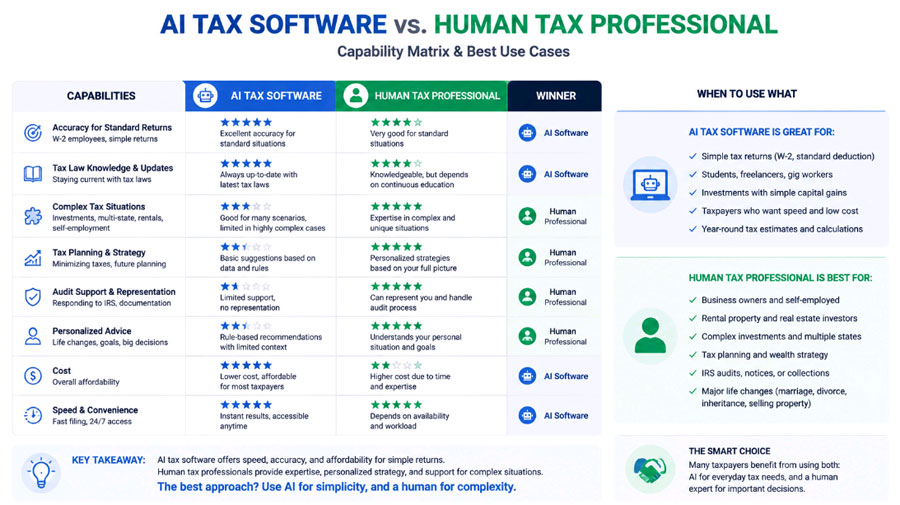
| Scenario | DIY Software (2026) | Human Professional |
|---|---|---|
| Single W-2, standard deduction | ✅ Excellent | Overkill |
| Freelance + one state | ✅ Solid | Marginal advantage |
| Multi-state + rental property | ⚠️ Manageable | Recommended |
| Business entity + employees | ❌ Insufficient | Essential |
| IRS audit response | ❌ Cannot represent you | Essential |
| International assets / FBAR | ❌ High risk | Essential |
Software won’t replace a CPA for genuinely complex situations. But for the median taxpayer — W-2 income, maybe a side project, standard deduction — the capability gap has nearly closed.
7. The Relationship Has Real Ongoing Costs
Working with a tax professional isn’t a one-time transaction. The best results come from a long-term relationship. That’s also where friction builds.
When your preparer retires, moves, or stops taking new clients, you lose institutional knowledge they’d built about your financial history. Starting over with someone new means re-explaining years of context — and paying for their learning curve.
There’s also the scheduling dependency. Year-round advisory access sounds valuable, but in practice, many preparers are stretched thin and slower to respond outside tax season. Calls go unreturned for days. Questions about a real estate transaction in July get answered in September.
Is It Still Worth Hiring a Tax Professional?
Yes — in specific situations. Here’s a clean breakdown:
Hire a professional if you have:
- Business income with employees or contractors
- Real estate sales, rental properties, or 1031 exchanges
- Foreign income, foreign accounts, or FBAR/FATCA obligations
- A major life event: divorce, inheritance, business sale
- An IRS notice or audit
Save your money if you have:
- A single W-2 and standard deduction
- Simple investment income (one brokerage account, no sales)
- Income under $84,000 and no significant deductions to itemize
Consider the hybrid approach: use tax software to organize your return, then pay a CPA for a one-hour review ($100–$175 at most firms). You get expert eyes without the full preparation fee.
FAQ: What People Actually Want to Know
Q: What is the biggest disadvantage of hiring a tax professional?
Cost unpredictability. The base fee rarely reflects the final bill once complexity fees, state returns, and ancillary services are added.
Q: What happens if my tax preparer makes a mistake?
You’re still liable to the IRS for any taxes, penalties, and interest owed. Your preparer may reimburse their fee if they carry E&O insurance, but the tax debt is yours.
Q: Is TurboTax as good as a CPA in 2026?
For straightforward returns, yes. For business entities, multi-state situations, audits, or international assets, no — the gap remains significant.
Q: How do I verify a tax preparer’s credentials before hiring?
Search the IRS Preparer Tax Identification Number (PTIN) directory at IRS.gov. Confirm CPA status through your state’s Board of Accountancy. Verify EA status through the IRS Return Preparer Office.
Q: Are tax preparation fees deductible in 2026?
For personal returns, no — the Tax Cuts and Jobs Act suspended this deduction through 2025, and current law does not restore it for 2026. For business returns, preparation fees remain deductible as a business expense.
The Bottom Line
The cons of hiring a tax professional are real: unpredictable costs, credential gaps, shrinking availability, and increasingly capable software alternatives. None of this means professionals aren’t worth it — it means the decision requires honest math, not default habit.
Match the tool to the job. A complex business return with rental income and multi-state filings genuinely needs a qualified CPA. A single W-2 with a standard deduction does not.
Know what you’re buying before you write the check.
Disclaimer: This article is for informational purposes only and does not constitute tax, legal, or financial advice. Tax laws are subject to change and vary by jurisdiction. Consult a licensed tax professional — ideally a CPA or IRS Enrolled Agent — before making any decisions based on your specific situation.