

The pros and cons of retiring early aren’t just about money — they’re about a bet on your own future health, discipline, and tolerance for risk. This guide breaks down what actually happens to your income, your insurance, and your identity when you leave the workforce years ahead of schedule.

What Counts as “Early Retirement”?
Full retirement age under Social Security sits at 66 or 67, depending on your birth year. Anything before that is technically early. But in practice, “early retirement” usually means leaving full-time work in your 40s or 50s — years before Medicare eligibility, years before penalty-free 401(k) access, and often decades before your savings would naturally mature.
This gap matters. It’s the reason the FIRE movement (Financial Independence, Retire Early) split into subcategories: Lean FIRE for minimalists, Fat FIRE for high earners who want to keep their lifestyle, Coast FIRE for people who stop saving but let compounding do the rest, and Barista FIRE for those who keep part-time work mainly for health benefits. Each solves a different version of the same problem — how do you fund 30+ years without a paycheck?
The Real Pros of Retiring Early
Time becomes yours again. You stop trading your best years for a salary. That sounds obvious, but the value compounds — more time with kids while they’re still young, more energy for travel, more room for work that pays nothing but matters.
Health outcomes often improve. Chronic job stress is linked to elevated cortisol and higher cardiovascular risk. [workplace stress cardiovascular research] Removing that daily pressure doesn’t guarantee better health, but it removes one major variable working against you.
You get your peak years back. Most people don’t retire early to do nothing — they retire early to do something else. Consulting, small business ventures, caregiving, creative work. Early retirement isn’t always the finish line; sometimes it’s a career pivot with better terms.
The Cons Nobody Puts in the Headline
Sequence of returns risk. This is the concept most articles skip entirely, and it’s arguably the biggest threat to an early retirement plan. If the market drops hard in your first five years of withdrawals, you lock in losses you can never fully recover from — even if the market rebounds later. A 50-year-old retiring into a downturn faces a fundamentally different outcome than someone retiring into a bull market, even with identical savings.
Social Security takes a hit. Your benefit is calculated from your highest 35 years of earnings. Retire at 50, and you’ll have zero-income years dragging that average down — sometimes significantly.
The 401(k) penalty trap. Withdraw from a traditional IRA or 401(k) before age 59½, and you’ll typically owe ordinary income tax plus a 10% early withdrawal penalty. [Rule of 55 401k withdrawals] There are exceptions, but they require planning years in advance — not decisions made after you’ve already quit.
You lose employer contributions and peak earnings. Many people hit their highest salary years in their late 40s and 50s. Walking away early means giving up both the paycheck and the employer match at the exact moment they’d have grown the fastest.
The identity gap is real. Work gives people structure, purpose, and a social circle they don’t replace easily. Retirees who don’t plan for this often describe the first year as harder emotionally than financially.
The Healthcare Gap: The Problem Everyone Underestimates
Medicare doesn’t start until 65. If you retire at 50, that’s a 15-year gap you have to cover yourself — and it’s the single most underestimated cost in early retirement planning.
| Coverage Option | What It Costs | Trade-Off |
|---|---|---|
| COBRA | Full premium plus admin fee, no employer subsidy | Keeps your existing plan, but expensive and time-limited (usually 18 months) |
| ACA Marketplace | Varies widely; income-based subsidies can lower cost significantly | Cheaper for lower-income early retirees, but plan quality varies by state |
| Private Insurance | Often the highest cost, especially with pre-existing conditions | More flexibility, less regulation on pricing |
ACA Marketplace subsidy eligibility
The smartest early retirees model their income specifically to qualify for ACA subsidies — sometimes deliberately keeping taxable income low in the years before Medicare kicks in.
How Much You Actually Need
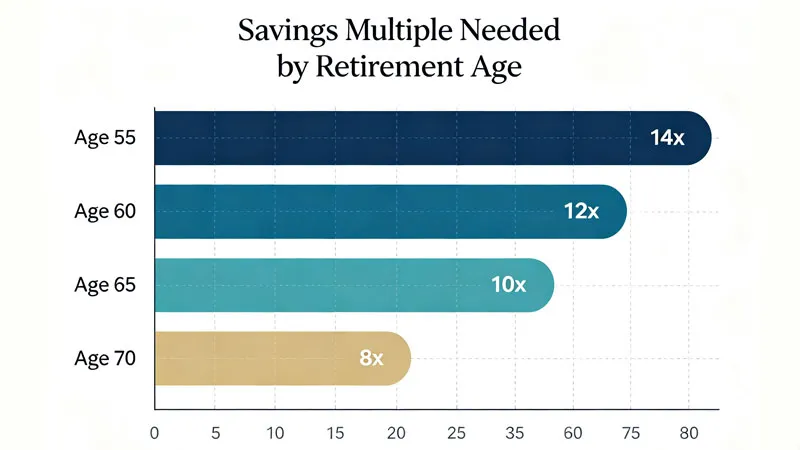
The widely used shorthand is the 4% rule: save 25 times your annual expenses, and a 4% annual withdrawal should sustain you through a standard 30-year retirement. Retire earlier than that, and most planners recommend a more conservative 3% to 3.5% withdrawal rate — because your money needs to last longer, not because the formula changes.
A quick comparison:
| Retirement Age | Years Until Social Security | Years of Self-Funded Healthcare | Suggested Withdrawal Rate |
|---|---|---|---|
| 50 | 12+ years | 15 years | 3.0%–3.25% |
| 55 | 7+ years | 10 years | 3.25%–3.5% |
| 60 | 2+ years | 5 years | 3.5%–4% |
How much to save for retirement
Strategies Financially Savvy Early Retirees Actually Use
A Roth conversion ladder lets you move traditional IRA funds into a Roth account gradually, paying tax now at (hopefully) lower rates, so you can access converted funds penalty-free after five years — a common bridge for people retiring in their 40s and 50s.
A taxable brokerage “bridge account” does something similar: it’s money held outside retirement accounts specifically to cover the years before you can touch your 401(k) or IRA without penalty.
Coast FIRE and Barista FIRE sit in between full early retirement and full-time work — part-time income covers current expenses while your existing retirement savings keeps compounding untouched.
Is Early Retirement Right for You?
Ask yourself five questions before you hand in notice: Have you modeled a market downturn in your first five years? Do you have a healthcare plan mapped out, not just a guess? Have you calculated your reduced Social Security benefit? Do you have income sources that don’t rely on selling investments in a down year? And — the one people skip — do you have a plan for your time, not just your money?
Frequently Asked Questions
Can I retire early and still collect Social Security?
Yes, starting at age 62, but your monthly benefit will be permanently reduced compared to waiting until full retirement age.
What is the Rule of 55?
If you leave your job in or after the year you turn 55, you can withdraw from that employer’s 401(k) without the 10% early withdrawal penalty. It doesn’t apply to IRAs.
How do I get health insurance if I retire before 65?
Your main options are COBRA, ACA Marketplace plans, or private individual insurance — each with different cost and coverage trade-offs.
Can I go back to work if I change my mind after retiring early?
Yes, though re-entering your field at the same level or salary isn’t guaranteed, especially after a multi-year gap.
How much should I have saved to retire at 55?
Most planners suggest 25 to 30 times your annual expenses, adjusted for a lower, more conservative withdrawal rate than the standard 4% rule.
Bottom Line
Retiring early isn’t a single decision — it’s a series of smaller ones about risk, healthcare, and how you want to spend your time. The financial math is solvable. The harder part is being honest about whether you’ve actually solved it, or just hoped you have.
Disclaimer: This article is for informational purposes only and does not constitute financial, tax, or legal advice. Retirement decisions depend on your individual circumstances — consult a certified financial planner, tax advisor, or licensed professional before making major changes to your retirement timeline.