

Financed a new car in 2025? Interest on car payments is now tax deductible — up to $10,000 per year — thanks to a law most buyers haven’t heard of yet. The One Big Beautiful Bill Act (OBBBA) quietly changed the rules. But eligibility is narrow, and missing one requirement means missing the deduction entirely. Here’s exactly what you need to know before you file.
What Changed: The OBBBA Brought Back Car Loan Interest Deductions
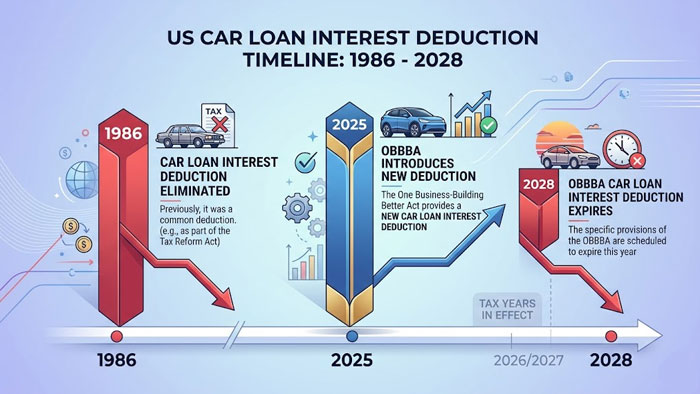
For nearly 40 years — since the Tax Reform Act of 1986 — personal car loan interest offered zero federal tax benefit. That ended on July 4, 2025, when President Trump signed the OBBBA (P.L. 119-21) into law.
Under IRC Sec. 163(h)(4), qualifying taxpayers can now deduct up to $10,000 per year in car loan interest on their federal return. The deduction is available for tax years 2025 through 2028 — whether you take the standard deduction or itemize. No need to change your filing approach to benefit.
Do You Qualify? Three Requirements You Must Meet
The deduction sounds simple. It isn’t. Three separate boxes need to be checked: the vehicle, the loan, and you.
Qualifying Vehicle Requirements
Your car must be:
- Brand new — used vehicles don’t qualify, even if they’re new to you. Lease buyouts are also excluded.
- Finally assembled in the United States — this is not the same as being a U.S. brand. A Honda Civic built in Ohio qualifies. A Ford Mustang assembled in Mexico does not.
- Under 14,000 lbs GVWR — covers cars, SUVs, minivans, pickup trucks, and motorcycles.
- VIN reported on your tax return — no VIN, no deduction.
To confirm U.S. final assembly, run the vehicle’s VIN through the [NHTSA VIN decoder tool]. Look for “Final Assembly Point” in the results.
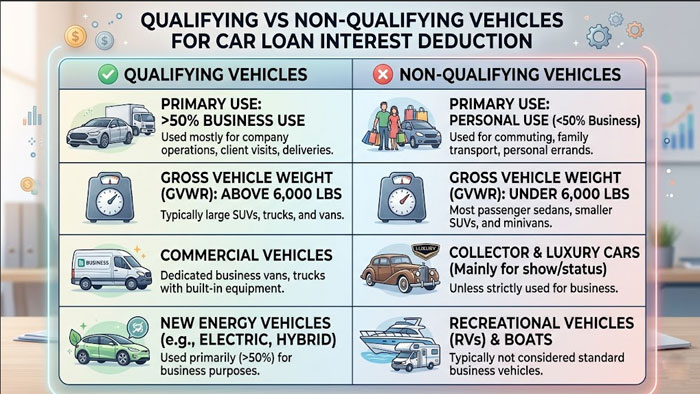
| Vehicle Type | Qualifies? | Note |
|---|---|---|
| New U.S.-assembled SUV (2025) | ✅ Yes | Verify VIN |
| Used vehicle | ❌ No | “New to you” doesn’t count |
| Lease buyout | ❌ No | Not a qualifying purchase |
| New import (foreign final assembly) | ❌ No | Even U.S. brands can fail this |
| New EV assembled in U.S. | ✅ Yes | See EV section below |
Qualifying Loan Requirements
The loan must be:
- Secured by a first lien on the vehicle
- Not owed to a related party — a loan from a family member or a business you own doesn’t count
- Originated between 2025 and 2028
- Used to finance the vehicle itself — but it can also cover sales tax, extended warranties, and dealer fees rolled into the loan
Co-borrowers and co-signers: This is a gap neither major competitor addresses. If two people share the loan, the deduction generally belongs to whoever actually makes the payments and claims the vehicle on their return. Keep clear payment records. The IRS has not issued explicit guidance here — a tax professional can help you navigate joint-loan situations.
Taxpayer Eligibility
You must intend to use the vehicle for personal use more than 50% of the time at the point of purchase. This is a one-time intent test — not an annual re-evaluation. Personal use includes use by your spouse and certain relatives.
Eligible filers include individuals, estates, and nongrantor trusts.
Income Limits: How the Phase-Out Works
The deduction doesn’t disappear at one income level — it phases out gradually.
| Filing Status | Phase-Out Starts | Fully Eliminated | Reduction Per $1,000 Over Threshold |
|---|---|---|---|
| Single / Estates / Trusts | $100,000 MAGI | $150,000 | $200 |
| Married Filing Jointly | $200,000 MAGI | $250,000 | $200 |
Example — Single filer, MAGI $120,000: $120,000 is $20,000 over the $100,000 threshold. At $200 reduction per $1,000 over, that’s a $4,000 reduction. Maximum deduction: $6,000.
Example — MFJ, MAGI $210,000: $10,000 over the $200,000 threshold × $200 = $2,000 reduction. Maximum deduction: $8,000.
Planning note: If your MAGI sits near the phase-out threshold, talk to a CPA about timing income or deductions to preserve more of this benefit. Deferring a year-end bonus or accelerating deductible expenses can shift the math meaningfully.
Special Scenarios: EVs, Business Use, Refinancing
Electric Vehicles and Hybrids
EVs and hybrids qualify under the same rules as conventional vehicles — new, U.S.-assembled, under 14,000 lbs GVWR. The car loan interest deduction and the §30D Clean Vehicle Credit are completely separate. Claiming one does not reduce or eliminate the other. You can stack both.
Popular EV assembly locations shift regularly as manufacturers adjust supply chains. Always verify through the NHTSA VIN tool — don’t assume based on brand or model.
§30D Clean Vehicle Credit eligibility and income limits
Business Use and Mixed-Use Vehicles
Using your car for both work and personal trips? You have two options — and the right choice depends on whether your income is in the phase-out range.
Option 1 — Keep it simple: Deduct all qualifying interest as car loan interest, up to the $10,000 cap.
Option 2 — Split strategically: Deduct the business-use portion as a business expense (Schedule C), and claim the remaining personal-use portion as car loan interest. The total car loan interest deduction gets reduced dollar-for-dollar by whatever you claim as a business expense.
If your income is near the phase-out ceiling, Option 2 may let you preserve more total deduction — because the business-use portion isn’t subject to the income phase-out.
Refinancing Your Car Loan
Refinancing doesn’t automatically kill the deduction — but it comes with two strict conditions:
- The new loan must remain a first lien on the same vehicle
- The new loan principal cannot exceed the original loan’s outstanding balance at the time you refinance
Cash-out refinancing — where you borrow more than you owe — disqualifies the excess amount. Only the interest on the original balance remains deductible.
How to Claim It: Step-by-Step
Step 1: Verify your vehicle’s U.S. final assembly via the NHTSA VIN decoder. Screenshot the result and save it.
Step 2: Get your interest total from your lender.
- 2025 tax year: No standardized form exists yet. Contact your lender directly for an annual interest summary — this can come from your online account, monthly statements, or a dedicated annual statement.
- 2026 and beyond: Lenders must issue Form 1098-VLI (Vehicle Loan Interest Statement) by January 31 for any loan on which you paid $600+ in interest.
Step 3: Calculate your allowable deduction. Apply the phase-out formula if your MAGI exceeds the threshold. Subtract any portion claimed as a business expense.
Step 4: File on Schedule 1-A, Part IV — titled “No Tax on Car Loan Interest” — alongside your Form 1040. Enter the VIN, total interest paid, and your adjusted deduction amount.
Documents to keep (in case of audit):
- Original loan agreement
- Lender interest summary (2025) or Form 1098-VLI (2026+)
- NHTSA VIN verification screenshot
- Purchase invoice showing vehicle price, taxes, and fees
- Mileage log (if claiming any business use)
Does Your State Honor This Deduction?
Federal deduction does not automatically mean state deduction. States follow federal tax law to varying degrees — a concept called “conformity.”
- Rolling conformity states (e.g., New York, Virginia) generally adopt federal changes automatically.
- Selective conformity states (e.g., California) pick and choose which federal provisions they follow. California historically decouples from federal tax changes that reduce revenue.
- No state income tax (e.g., Texas, Florida) — this question is irrelevant.
If you live in California or another selective conformity state, don’t assume you get a state-level deduction. Check your state tax authority’s website or ask a local CPA.
How Much Will You Actually Save?
Here’s a realistic look at what this deduction means in dollars — not theory.
| Scenario | Loan Amount | Rate | Annual Interest | MAGI | Fed. Tax Rate | Est. Annual Savings |
|---|---|---|---|---|---|---|
| Single, mid-income | $35,000 | 7.0% | ~$2,200 | $75,000 | 22% | ~$484 |
| MFJ, near phase-out | $55,000 | 7.5% | ~$3,800 | $210,000 | 24% | ~$672 (partial) |
| MFJ, maximized | $85,000 | 8.5% | ~$6,600 | $160,000 | 24% | ~$1,584 |
Honest take: For most middle-income buyers, this deduction saves $400–$800 per year. Real money — but not enough to justify a car purchase you otherwise wouldn’t make. Think of it as a bonus for a decision you were already planning.
FAQ: Car Loan Interest Deduction
Is car loan interest tax deductible on a used car?
No. Only brand-new vehicles qualify. A pre-owned vehicle — regardless of how recently it was made — is ineligible.
Can I claim the car loan interest deduction and the EV tax credit?
Yes. These are separate provisions. The §30D credit and the car loan interest deduction can both be claimed on the same return for the same vehicle.
My car was purchased in late 2024. Can I deduct 2025 interest payments?
The deduction is based on when the loan was originated, not when interest was paid. If your loan originated before January 1, 2025, it does not qualify — even if you’re making payments in 2025.
What if my lender doesn’t send me a Form 1098-VLI?
For tax year 2025, lenders are not required to issue a standardized form. Contact your lender directly and request an annual interest statement. For 2026 and beyond, lenders issuing $600+ in annual interest must provide Form 1098-VLI by January 31.
What happens to this deduction after 2028?
The OBBBA authorization expires December 31, 2028. Congress would need to pass new legislation to extend it. There is no guarantee of renewal. Plan accordingly — don’t finance a vehicle in 2027-2028 assuming a 2029 extension.
Bottom Line
The OBBBA car loan interest deduction is real, meaningful, and time-limited. If you financed a new, U.S.-assembled vehicle in 2025 and your income falls below the phase-out ceiling, you’re likely leaving money on the table by not claiming it.
Check your VIN. Get your interest total from your lender. File Schedule 1-A. And if your situation involves business use, a co-borrower, or a state with selective conformity, get a CPA involved before you file.
The deduction runs through 2028. Use it.
Disclaimer: This article is for informational purposes only and does not constitute tax, legal, or financial advice. Tax laws are complex and subject to change. Individual circumstances vary. Consult a licensed CPA or tax professional before making any tax-related decisions.