

Car lease credit score tiers decide more than approval — they set your actual monthly payment before you ever sit down at the desk. Most shoppers find this out the hard way, after the dealer quotes a number nowhere near the ad. This guide breaks down exactly what each tier costs, what dealers won’t volunteer, and what to do if your score isn’t where you want it yet.

Quick Answer: What Credit Score Do You Need to Lease a Car?
Most captive lenders want a score of 700 or higher for their best pricing. Scores between 620 and 699 can still get approved, just at a higher cost. Below 620, standard lease programs usually decline you, though alternative paths exist.
There’s no single national cutoff. Toyota Financial doesn’t use the same tiers as Ally or BMW Financial Services. Your score is one input among several — the lender, the vehicle, and the timing all shape your final offer.
view Experian’s quarterly automotive credit data
Key Takeaways
- Lenders typically require 700+ for top-tier lease pricing; 620-699 still has options.
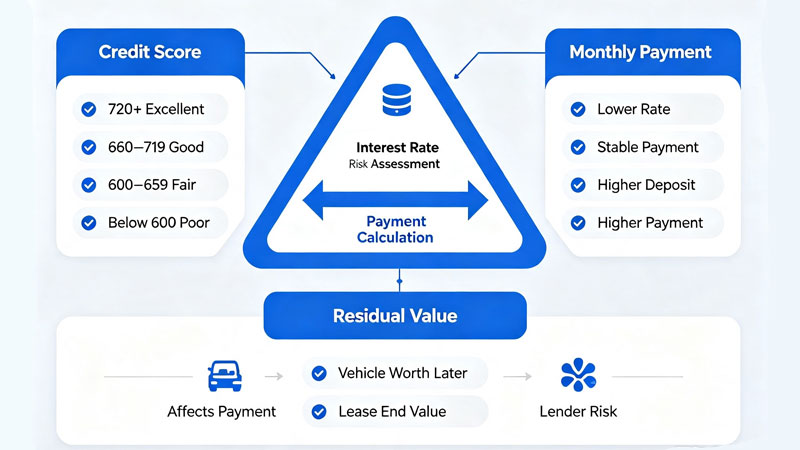
- Your score sets your money factor — the lease industry’s version of an interest rate.
- Dealers can mark up the money factor above what the lender charges and pocket the spread.
- The score in your banking app isn’t always the score your lender pulls.
- You can shop multiple lease programs within a short window without stacking credit damage.
How Car Lease Credit Score Tiers Actually Work
What a Money Factor Is and How Your Score Sets It
Every lease uses a money factor instead of an APR. Multiply the money factor by 2,400 and you get something close to the equivalent interest rate. A money factor of .00125 works out to roughly 3% APR. Higher tier, lower factor, lower payment. That’s the entire mechanism in one sentence — everything else is detail.
FICO Auto Score vs. Your Everyday Credit Score
Here’s what most articles skip. The score sitting in your banking app is usually a base FICO or VantageScore. Lenders pull a FICO Auto Score instead, and it weights your history with car payments and installment debt more heavily than a generic score does. Someone with strong credit card habits but no auto loan history can see a real gap between the two numbers. Pull your actual auto score before you shop, not the one from a free app.
Credit Tier Breakdown Table
| Tier | Score Range | Approval Odds | Money Factor Impact | Est. Payment Difference* | Deposit Likely? |
|---|---|---|---|---|---|
| Super Prime | 750+ | Very high | Lender’s best rate | Baseline | No |
| Prime | 700-749 | High | Slightly elevated | +$10-30/mo | Rarely |
| Near Prime | 650-699 | Moderate | Meaningfully higher | +$40-80/mo | Sometimes |
| Subprime | 620-649 | Low-moderate | Significantly higher | +$80-150/mo | Often |
| Deep Subprime | Under 620 | Low, program-dependent | Often declined | Requires alt. structure | Usually |
Based on a mid-size SUV lease; actual figures vary by lender and current incentives.
What Dealers Don’t Explain About Your Score
Buy Rate vs. Marked-Up Money Factor
Lenders hand dealers a buy rate — the actual base cost. Dealers can mark that number up and keep the difference. Two shoppers with identical scores can walk into two different dealerships and get two different payments on the same car. This isn’t illegal, but it isn’t disclosed either. It’s why shopping matters more than most people assume.
compare current lease offers by credit tier
Why the Advertised Price Almost Never Applies to You
That $299/month ad assumes Super Prime credit, a 36-month term, and a 10,000-mile annual cap. Change any one of those and the number changes with it. If your credit sits in the 690s or you drive more than average, the ad was never built for you.
Beyond Your Score: Other Factors That Move Your Payment
Residual Value — Fixed, Not Negotiable
This is the manufacturer’s estimate of what the car will be worth at lease end. You can’t talk it down. A higher residual value means a lower payment, full stop.
Capitalized Cost — The Number You Can Negotiate
This is the selling price baked into your lease. Negotiate it the way you’d negotiate a purchase price, because that’s exactly what it is.
Debt-to-Income Ratio Still Matters, Even With Good Credit
Lenders generally want your total debt payments under 35-40% of gross monthly income. A 720 score with a DTI over that threshold can still get a worse offer than a 690 score with room to spare. Both numbers get checked.
Can You Lease a Car With Bad Credit?
What Happens at Each Subprime Tier
At 620-649, some lenders decline outright. Others approve with a larger drive-off or a shorter term. Below 620, most standard programs stop working entirely, and you’re looking at manufacturer subprime channels or a different financing structure altogether.
Co-Signers: The Risk Nobody Mentions
A co-signer with strong credit can open doors your score alone can’t. But that person is legally on the hook for every missed payment, and it shows up on their credit file too — not just yours. This is a real financial commitment for them, not a formality. Both parties should understand that before signing anything.
When Financing Beats Leasing for Lower Scores
Leasing only finances the car’s depreciation. Buying finances the full purchase price. That sounds like leasing should be easier to qualify for, but lenders treat lease risk more conservatively because they own the car at the end. If your score sits under 650, a standard auto loan often has more flexible approval paths than a lease does.
read our lease vs. finance comparison guide
Fixing Your Score Before You Apply
Dispute errors first. Under the Fair Credit Reporting Act, bureaus have 30 days to investigate a dispute. A wrongly reported late payment or an account that isn’t yours can cost you real points.
Cut your utilization. Getting credit card balances under 30% of your limit can move your score within 30-60 days. Payment history and utilization together make up most of your score.
Stop opening new credit right before you shop. Each hard inquiry causes a small, temporary dip. Save the new credit card for after you sign.
learn how credit disputes work
Soft Pull vs. Hard Pull: The Shopping Window Nobody Explains
Multiple auto-related credit inquiries within a short window — typically 14 to 45 days depending on the scoring model — usually count as a single inquiry. This means you can compare offers across several dealers without stacking damage to your score. Ask upfront whether a quote requires a hard pull or a soft pull, and don’t let anyone run your credit before you’re ready to move forward.
Lease vs. Finance vs. Wait: A Quick Decision Guide
| Your Situation | Best Path |
|---|---|
| 700+, want the lowest payment | Lease now, compare 2-3 lenders |
| 650-699, need a car soon | Compare a lease with deposit against financing used |
| Under 620, can wait 60-90 days | Fix errors and utilization first |
| Under 620, can’t wait | Look at a co-signer or a subprime auto loan |
Frequently Asked Questions
Does leasing a car build credit?
Yes, most lease payments get reported to the major bureaus. On-time payments help your history the same way an auto loan would.
Will applying for a lease hurt my credit score?
A hard inquiry causes a small, temporary dip. Rate-shopping within a short window typically counts as one inquiry, not several.
Can I lease with no credit history at all?
It’s harder, not impossible. A co-signer or a manufacturer program built for first-time buyers is usually the path forward.
Is it easier to lease or finance with a 620 credit score?
Financing generally has more flexible approval paths at that score, since lenders treat the full loan amount differently than lease depreciation risk.
What happens to my co-signer if I miss a payment?
It shows up on their credit report too, and they’re legally responsible for the payment. This isn’t a small ask.
Disclaimer: This article is for general educational purposes only and does not constitute financial, legal, or investment advice. Credit tiers, money factors, and approval terms vary by lender and change over time. Speak with a licensed lender or financial advisor before making leasing or financing decisions.