

A mobile food truck business plan is the single document that decides whether a lender says yes or no. Most first-time owners write one that reads like a dream, not a forecast. This guide fixes that. You’ll get a realistic cost breakdown, financing options, and a break-even formula you can run today.
What Makes a Mobile Food Truck Business Plan Different From a Restaurant Plan
A food truck plan carries weight a restaurant plan doesn’t. Location strategy replaces lease negotiation. Route planning replaces foot traffic analysis. Permits shift from one city to potentially several counties.
Startup costs also sit at a fraction of a restaurant’s. Most trucks launch for $50,000 to $200,000, compared to $175,000 to $750,000+ for a brick-and-mortar space, according to industry data restaurant startup cost data.
That lower barrier explains the rush into the industry. It also explains why over half of new trucks close within three years. A plan built on real numbers, not hope, is what separates the two outcomes.
Step 1: Build an Executive Summary That Investors Remember
Write this section last, even though it goes first. Cover four things: your concept, your target customer, your competitive edge, and your funding ask.
What to Include in Your Mission Statement
Skip the generic “passion for food” language. State the gap you’re filling. Are you the only Korean fusion truck in a downtown lunch corridor? Say that. Specificity signals you’ve done the research, not just the daydreaming.
Step 2: Prove Market Demand With Real Research
Lenders reject plans that skip competitor analysis more than any other section. Walk your target area. Count competing trucks. Note their prices, hours, and lines.
Identifying Your Target Customer
Office workers want speed between noon and 1 p.m. Festival crowds want shareable, photogenic food. Families at weekend markets want kid-friendly options at a fair price. Pick one primary customer and build your menu around them.
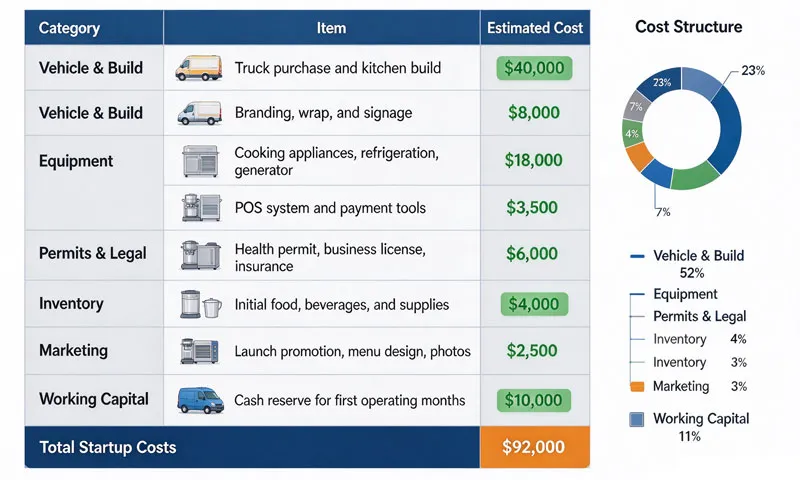
Step 3: Calculate Realistic Food Truck Startup Costs
This is where most plans fall apart. Owners budget for the truck and forget everything around it.
Buying vs. Leasing: A Straight Comparison
| Factor | Buying | Leasing |
|---|---|---|
| Upfront cost | High ($50K–$200K) | Low (monthly payments) |
| Long-term cost | Lower over 5+ years | Higher over time |
| Ownership | Full equity in asset | No equity built |
| Best for | Owners with capital or a loan approved | Owners testing the concept first |
| Flexibility | Harder to exit | Easier to walk away |
The Hidden Costs Nobody Budgets For
Commissary kitchen rental runs $500 to $2,000 a month in most cities. Off-season storage, generator maintenance, and POS system fees add up fast. Build a 15% contingency line into your budget. Skip it, and you’ll be underfunded by month three.
Step 4: Choose the Right Financing for Your Food Truck
Financing is where most guides go thin. It shouldn’t be.
SBA Loans vs. Secured Vehicle Loans vs. Equipment Financing
| Loan Type | Typical Rate Range | Collateral | Approval Speed | Best Fit |
|---|---|---|---|---|
| SBA 7(a) Loan | 10.5%–14% (variable) | Business assets | 30–90 days | Owners with strong credit and time to wait |
| Secured Vehicle Loan | 6%–15% | The truck itself | 1–2 weeks | First-time owners needing speed |
| Equipment Financing | 8%–20% | Kitchen equipment | 1–3 weeks | Owners buying gear separately |
Rates shift with the market, so confirm current terms before you apply SBA 7(a) loan program details.
What Lenders Actually Check in Your Plan
Lenders look past your concept straight to your numbers: debt-to-income ratio, collateral value, and whether your break-even math holds up under stress. A plan with vague projections gets declined regardless of how good the food is.
Step 5: Run Your Break-Even Analysis
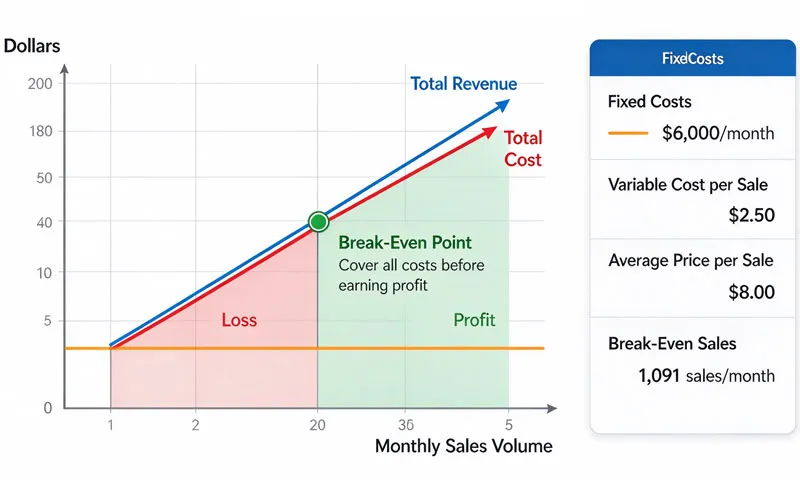
The formula is simple: (Fixed Costs + Variable Costs) ÷ Average Profit Per Sale = Break-Even Units.
Here’s a real example. Say your fixed monthly costs (truck payment, insurance, permits) total $3,000. Variable costs per sale (ingredients, packaging) run $3, and you sell each item for $12. Your profit per sale is $9.
$3,000 ÷ $9 = 334 sales per month, or about 12 sales a day, to break even.
Run this same math against a slow month and a festival weekend. That range tells you how much cash reserve you actually need food truck profit margin calculator.
Step 6: Handle Licenses, Permits, and Insurance Correctly
Requirements vary by state and even by county, so treat this section as a framework, not a final checklist.
The Core Permits You’ll Need
You’ll typically need a business license, a food service permit from your local health department, and a mobile vending or parking permit. Some cities also require a fire safety inspection for propane equipment.
Insurance Types You Can’t Skip
- General liability insurance — covers customer injuries or property damage
- Commercial auto insurance — covers the truck itself while driving and parked
- Product liability insurance — covers claims related to foodborne illness
Skipping any of these three leaves a gap most owners don’t discover until they need the coverage mobile food business license requirements.
Step 7: Plan for Slow Seasons Before They Hit
Winter and off-peak months break more food trucks than bad food does. Build alternate revenue into your plan now: private catering, office lunch contracts, and delivery app partnerships all keep cash moving when foot traffic drops.
One owner in Denver shifted to weekly office catering contracts each January, covering nearly 40% of fixed costs during the slowest quarter. That kind of backup plan belongs in your financial projections, not as an afterthought.
Frequently Asked Questions
How much does a mobile food truck business plan cost to put together?
If you write it yourself using a template, it costs nothing but time. Hiring a consultant typically runs $500 to $2,500 depending on complexity.
What’s the average profit margin for a food truck?
Most trucks run a 6% to 9% net profit margin, though well-managed operations with low food costs can reach into the mid-teens.
Do I need a business plan if I’m self-funding my truck?
Yes. Even without a lender to satisfy, the plan forces you to test your numbers before you spend real money on a truck.
How long does it typically take to break even?
Most food trucks break even between 12 and 18 months, depending on location, startup debt, and how quickly they build repeat customers.
Can I run a food truck business part-time?
It’s possible for catering or weekend-only models, but daily lunch-service trucks generally need full-time attention to hit break-even targets.
Disclaimer: This article is for informational purposes only and does not constitute financial, legal, or investment advice. Startup costs, loan terms, and permit requirements vary by location and change over time. Consult a licensed accountant, attorney, or business advisor before making financial or legal decisions for your food truck business.