

You want to know how to start a daycare with no money, and you’re tired of articles that just tell you to “write a business plan” and move on. Here’s the real answer: you can launch a home-based daycare for close to zero upfront cash if you stack grants, defer non-essential spending, and skip the mistakes that sink first-time providers.
Is Starting a Daycare With No Money Actually Realistic?
Let’s be honest first. “No money” rarely means zero dollars. It means you’re not walking in with $30,000 in savings.
Most providers who “start with nothing” actually spend somewhere between $0 and $2,000 out of pocket before their first paying family walks in. They cover the rest through grants, donated supplies, and revenue from their first few enrollments.
That’s the real playbook. Not magic. Just sequencing.

Home-Based vs. Center-Based: Which One Fits a Zero-Budget Start?
If your budget is tight, this decision isn’t really a choice. It’s math.
| Factor | Home-Based | Center-Based |
|---|---|---|
| Startup cash needed | $0–$5,000 | $30,000+ |
| Licensing timeline | Weeks to a few months | 6–12 months |
| Enrollment cap | 6–12 kids (state-dependent) | No hard cap |
| Realistic for $0 start | Yes | No |
Why Home-Based Wins When Capital Is Limited
You already own the furniture. You already pay the rent or mortgage. You’re not adding a commercial lease on top of a business you haven’t tested yet.
Start here. Scale to a center later, once revenue proves the model works.
Step 1: Check Your State’s Licensing Rules Before You Spend Anything
This step gets skipped constantly. People buy toys and cribs before they know their state’s ratio requirements or square-footage rules. Then they have to redo everything.
License-Exempt Thresholds
Most states let you watch a small number of children — often four to six — without a license. Confirm your state’s exact number before enrolling a single family.
Free Help From CCR&R Agencies
Every state has a Child Care Resource & Referral agency. They’ll walk you through licensing steps at no cost. Use them before you use a search engine.
State daycare licensing requirements
Step 2: Find the Money That Doesn’t Require Repayment
This is where most guides go vague. Here’s the breakdown that actually matters.
CCDF Grants
The Child Care and Development Fund sends money to states, and states use part of it for provider startup and expansion grants. Amounts and eligibility vary by state, so check your state’s lead agency directly.
CACFP Reimbursement
The Child and Adult Care Food Program won’t fund your launch, but it reimburses you for meals once you’re operating. That’s real monthly cash flow you can plan around.
SBA Microloans
If grants don’t cover everything, SBA microloans go up to $50,000 and often work with newer, smaller businesses that traditional banks turn away.
Child Care and Development Fund overview
Step 3: Handle the Legal Basics Most Guides Skip
This section gets ignored in almost every daycare startup article. That’s a problem, because skipping it costs people far more than the money they saved.
LLC or Sole Proprietorship?
A sole proprietorship costs nothing to set up. An LLC costs a filing fee but separates your personal assets from business liability. If a child gets hurt on your watch, that separation matters.
Get an EIN — It’s Free
Takes ten minutes on the IRS website. You’ll need it for a business bank account, and running your daycare cash through a separate account keeps you sane at tax time.
Insurance Isn’t Optional
Skipping liability insurance to save $100 a month is the single most expensive mistake new providers make. One incident without coverage can end the business — and put your personal assets at risk.
Risk note: Operating without liability coverage exposes you personally to medical and legal costs if a child is injured in your care. This isn’t a corner worth cutting.
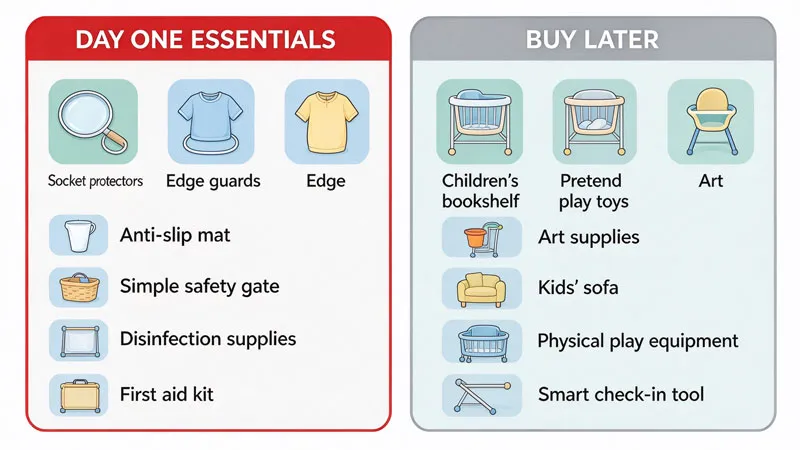
Step 4: Launch With What You Already Own
Zero-cost providers don’t buy everything new. They sequence purchases around cash flow.
Day 1 must-haves:
- First aid kit
- Smoke detectors and outlet covers
- Basic safety gates
- Signed enrollment and emergency contact forms
Can wait until month 2 or 3:
- New furniture upgrades
- Branded signage
- Additional educational materials
Check community donation groups, local libraries, and other providers who are downsizing. Toys, books, and nap mats show up in these networks constantly, often free.
Step 5: Write a Business Plan You Can Actually Use
You don’t need a consultant. You need three numbers: your break-even enrollment, your monthly fixed costs, and your realistic ramp-up timeline.
Most home providers hit break-even between month three and month six. Plan your cash reserve around that window, not around a best-case scenario.
Daycare startup cost breakdown
Step 6: Get Your First Families Without Spending on Ads
- List free on Winnie and local parent Facebook groups
- Offer a referral discount to your first five families instead of paying for ads
- Partner with a nearby employer or church that has parents looking for care
Your first families come from trust, not impressions.
Frequently Asked Questions
Can I legally start a daycare with $0?
Not entirely, but you can get close. Most out-of-pocket cost gets replaced by grants, donated supplies, and your own existing space.
How many children can I watch before I need a license?
It varies by state, usually between four and six. Confirm the exact number with your state’s licensing office before enrolling anyone.
Do daycare grants need to be repaid?
No. Grants are gifts, not loans. That’s why they’re competitive — apply early and follow the eligibility rules exactly.
How long until a home daycare becomes profitable?
Most providers break even between three and six months, once enrollment fills three to four spots.
What’s the cheapest insurance option for a home-based provider?
Costs vary by state and provider, but many home-based operators bundle general liability with their homeowner’s policy rider. [small business insurance for childcare providers] Get quotes from at least two providers before deciding.
Disclaimer: This article is for general informational purposes only and does not constitute legal, financial, or tax advice. Licensing rules, grant availability, and insurance requirements vary by state and change over time. Consult a licensed attorney, accountant, or your state’s child care licensing agency before making business decisions.