

What happens to your 401(k) when you die depends on one form most people never fill out correctly: the beneficiary designation. Get it wrong, and your retirement savings could sit in probate for months while your family waits. Here’s exactly how the rules work — and how to fix the gaps before they become a problem.
What Happens to a 401(k) When You Die?
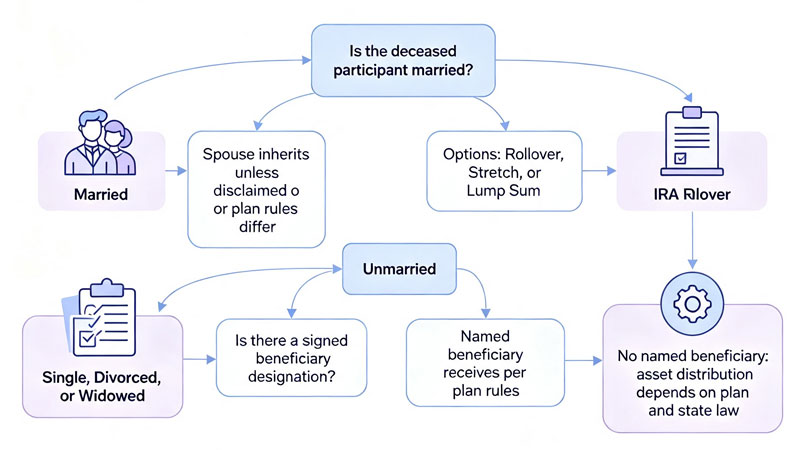
Your 401(k) doesn’t pass through your will. It passes directly to whoever you named on your beneficiary designation form, outside of probate. This single fact trips up more families than any other part of estate planning.
If you named a beneficiary, they inherit the account balance directly from the plan administrator. If you didn’t, your plan’s default rules kick in — and those rules vary by employer, not by what you’d actually want.
Why a Will Can’t Override Your 401(k)
Retirement accounts governed by ERISA operate on contract law, not probate law. The beneficiary form is the contract. Even a notarized will naming someone else won’t change who gets the money — the plan administrator is legally required to follow the form on file.
This is the single most common estate-planning mistake: people update their will after a divorce or remarriage but forget the 401(k) form sitting in an old HR file.
Primary vs. Contingent Beneficiaries — And Per Stirpes vs. Per Capita
You can name multiple primary beneficiaries and split the account by percentage. Contingent beneficiaries only inherit if every primary beneficiary has already died.
Two designation styles change what happens if a beneficiary dies before you:
| Designation | What Happens if a Beneficiary Dies First |
|---|---|
| Per Stirpes | Their share passes down to their own children |
| Per Capita | Their share gets split among your surviving beneficiaries instead |
Example: You’re unmarried and name your brother and sister 50/50. Your brother has two daughters and dies before you. Under per stirpes, his daughters split his 50%. Under per capita, your sister takes the full 100%.
What Happens If You Die Without Naming a 401(k) Beneficiary?
No named beneficiary doesn’t mean no rules — it means your plan’s default order takes over, and that order is rarely what you’d have chosen.
The Default Order of Succession
Most plans default to your spouse first. If you have no spouse, the account typically flows into your estate — which means probate.
Why This Triggers Probate — And What It Costs
Probate is a public court process that verifies your will and settles debts before assets reach heirs. It typically takes several months to over a year, and legal and administrative fees can consume a meaningful percentage of the estate’s value, according to [Consumer Financial Protection Bureau explains probate costs and timelines]. Probate rules and timelines also vary significantly by state, so check your state’s specific process before assuming a default outcome.
Spousal Beneficiaries: Rollover Rights Non-Spouses Don’t Get
Spouses get options nobody else gets under federal law.
Rolling an Inherited 401(k) Into Your Own IRA
A surviving spouse can roll the account into their own IRA and treat it as if it were always theirs. That means required minimum distributions (RMDs) don’t start until age 73, and the spouse controls the timeline entirely.
| Option | RMD Start | Early Withdrawal Penalty |
|---|---|---|
| Spousal Rollover (own IRA) | Age 73 | 10% if withdrawn before 59½ |
| Keep as Inherited IRA | Based on deceased’s age | No penalty, but less flexibility |
The Consent Rule Most Couples Don’t Know About
If you want to leave more than 50% of your 401(k) to someone other than your spouse, most plans require your spouse’s written, notarized consent. Skip this step, and the designation may not hold up.
understanding spousal consent requirements for retirement accounts
Non-Spouse Beneficiaries: The SECURE Act 10-Year Rule
This is where most competing articles stop short — and where the real complexity lives.
Eligible Designated Beneficiaries (EDBs) Get Different Treatment
Not every non-spouse beneficiary faces the same clock. The IRS carves out a category called Eligible Designated Beneficiaries, which includes minor children of the account owner, disabled or chronically ill individuals, and beneficiaries less than 10 years younger than the deceased. EDBs can often stretch distributions over their own life expectancy instead of the standard 10-year window.
How the 10-Year Rule Actually Works
Most other non-spouse beneficiaries must empty the account within 10 years of the owner’s death. Here’s the part that trips people up: if the original owner had already started RMDs before dying, the IRS’s finalized 2024 regulations require the beneficiary to keep taking annual distributions throughout the 10-year window — not just a lump sum at the end, according to [IRS final regulations on inherited retirement account distributions].
| Scenario | Annual Withdrawals Required? | Final Deadline |
|---|---|---|
| Owner had already started RMDs | Yes, annually | End of year 10 |
| Owner hadn’t started RMDs yet | No, flexible timing | End of year 10 |
Minor Children: When Does the Clock Actually Start?
A minor child counts as an EDB — but only until they reach the age of majority. Once they turn 18 (or up to 21 in some states), the standard 10-year countdown begins from that point, not from the date of death. Missing this detail can lead to major, avoidable tax penalties.
Distribution Options Compared
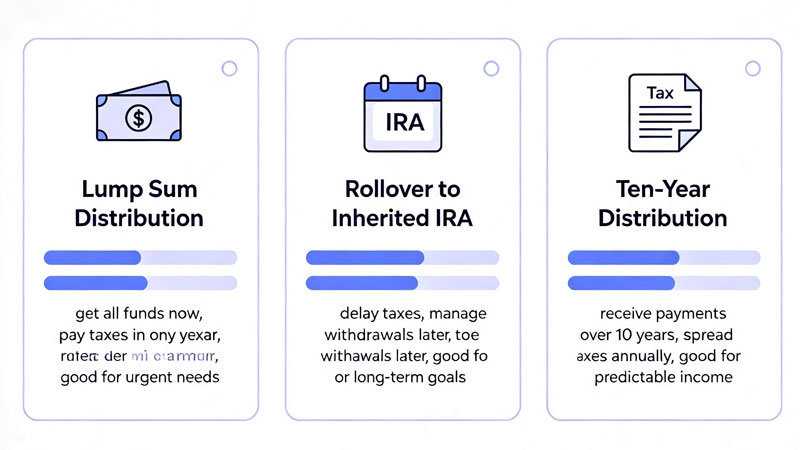
| Option | Tax Impact | Access to Funds | Best For |
|---|---|---|---|
| Lump Sum | Full amount taxed as income in one year | Immediate | Small balances only |
| IRA Rollover (spouse) | Deferred until withdrawal | Flexible | Spouses planning long-term |
| 10-Year Spread | Taxed as withdrawn | Gradual | Non-spouse beneficiaries managing tax brackets |
Tax Implications for Beneficiaries
Traditional vs. Roth: Why the Account Type Changes Everything
Withdrawals from an inherited traditional 401(k) count as ordinary taxable income. A Roth 401(k) held for at least five years passes to heirs tax-free — the growth and contributions both come out clean.
If you’re the account owner reading this while you still can, converting part of a traditional 401(k) to Roth now can meaningfully reduce the tax bill your heirs eventually face. Spreading the conversion over several years helps avoid pushing yourself into a higher bracket in any single year.
The Costly Mistake: Cashing Out Too Fast
Pulling the full balance in one year often pushes beneficiaries into a much higher tax bracket than spreading withdrawals across several years would. A financial planner can model the bracket impact before you touch the money — this single conversation often saves thousands.
Can Creditors Claim Your 401(k) After Death?
No. ERISA shields 401(k) assets from creditors both during your life and at the moment of transfer to your named beneficiary. Your executor settles outstanding debts from your estate, not your retirement account — unless no beneficiary was named, in which case the funds become part of the estate and are exposed to creditor claims.
One catch: once the money lands in the beneficiary’s own account, that protection may not travel with it. Inherited IRAs, in particular, don’t carry the same creditor shield in every state, so check your state’s exemption rules.
A Quick Checklist to Protect Your Family Now
- Name both primary and contingent beneficiaries
- Choose per stirpes if you want a deceased beneficiary’s share to pass to their kids
- Review your designations after every marriage, divorce, birth, or death
- Get spousal consent in writing if leaving over 50% elsewhere
- Consider a partial Roth conversion to ease your heirs’ tax burden
- Leave your executor a document listing account details and plan contacts
Frequently Asked Questions
Does my spouse automatically get my 401(k) if I never named a beneficiary?
In most plans, yes — federal default rules give spouses first priority when no beneficiary is on file.
Can my ex-spouse still inherit my 401(k) after our divorce?
Yes, if you never updated the form. Divorce doesn’t automatically remove an ex-spouse as beneficiary — you must file a new designation.
Do beneficiaries pay the 10% early withdrawal penalty on an inherited 401(k)?
No. The 10% early withdrawal penalty generally doesn’t apply to inherited accounts, regardless of your age. Ordinary income tax still applies to withdrawals.
What happens if my named beneficiary died before me and I never updated the form?
Without a per stirpes designation, their share typically gets redistributed among your other named beneficiaries — not passed to the deceased beneficiary’s children.
Disclaimer: This article is for general informational purposes only and does not constitute financial, tax, or legal advice. Rules governing 401(k) plans, beneficiary designations, and estate taxes vary by plan and jurisdiction and are subject to change. Consult a licensed financial advisor, CPA, or estate planning attorney before making decisions about your retirement accounts.