

Does bad credit history affect visa approval? Not directly — but it’s not irrelevant either. If you’re prepping a green card, work visa, or sponsorship case, your financial paper trail matters more than your three-digit score. This guide breaks down exactly what immigration officers check, what they ignore, and how to protect your application either way.
Credit Score vs. Financial History: Two Different Things Immigration Officers Check
Most people conflate these. Immigration officers don’t.
Your credit score measures repayment behavior on loans and cards. It’s a lending tool, built for banks. USCIS and consular officers care about something broader: can you support yourself without becoming a public charge, and can your sponsor back that up on paper?
That means officers look at bank statements, tax returns, employment letters, and the I-864 Affidavit of Support. A FICO score rarely appears anywhere in that packet.
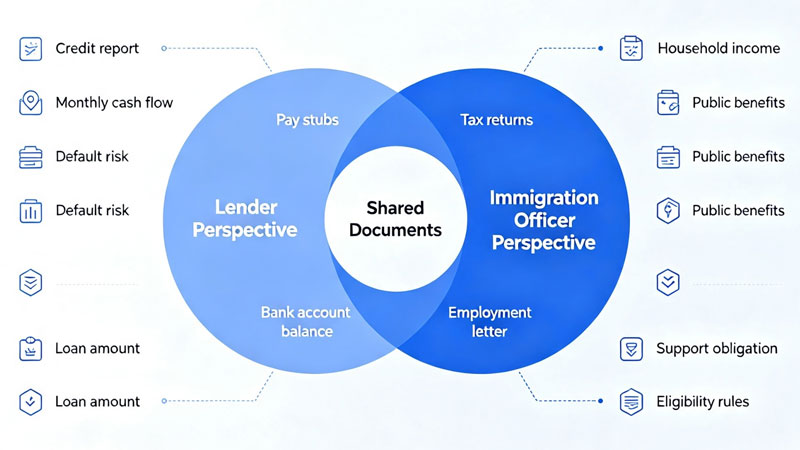
Affidavit of Support requirements
Does Bad Credit History Affect Visa Approval by Category?
The answer changes depending on which visa you’re filing.
Family-Based Green Cards and the I-864 Sponsor Requirement
Here’s what matters: your sponsor’s income and assets, not your credit score. Sponsors must hit 125% of the Federal Poverty Guidelines. If a sponsor’s finances fall short — often flagged by heavy debt or a recent bankruptcy — USCIS may require a joint sponsor. That’s the real risk point, and it’s about cash flow, not credit history.
Employment-Based Visas (H-1B, L-1, O-1)
Standard H-1B filings never touch your personal credit. Exception: roles requiring a security clearance or work in finance and government contracting. Employers running background checks for those positions may pull credit reports as part of a broader vetting process — not as a standalone dealbreaker.
Student Visas (F-1/J-1)
Consulates want proof of funds — a bank letter or sponsor affidavit. They don’t pull credit reports. Schools might check credit only if you’re financing tuition through a private lender, which is a separate transaction entirely.
Tourist Visas (B-1/B-2)
Consular officers weigh “ties to home country” — job, property, family — far more heavily than any financial score. Credit history essentially never enters this conversation.
Comparison Table: Visa Type vs. Financial Review
| Visa Type | Credit Score Checked? | What Actually Gets Reviewed |
|---|---|---|
| Family Green Card (I-864) | No | Sponsor’s income, tax returns, assets |
| H-1B / L-1 (standard roles) | No | Employer petition, job offer letter |
| H-1B / clearance-required roles | Sometimes | Background check, credit history |
| F-1 / J-1 Student Visa | No | Bank statements, sponsor letter |
| B-1/B-2 Tourist Visa | No | Ties to home country, travel history |
The Public Charge Rule in 2026: What Still Applies
The 2019 public charge rule expanded what counted against applicants. It got rolled back in 2021. Since then, USCIS has returned to a narrower standard: cash assistance for income maintenance and long-term institutional care at government expense.
Credit card debt, medical bills, or a low score don’t fall under this definition. That’s a persistent myth worth killing.
Current public charge policy guidance
Policy can shift with each administration. Check the source directly before you file, not a blog post from two years ago — including this one.
When Credit History Actually Creates Problems
There are real scenarios where it bites.
- A sponsor with poor credit may need a joint sponsor to satisfy the Affidavit of Support. This is the single biggest indirect impact most families encounter.
- Security-clearance jobs treat unpaid debt and bankruptcy as risk indicators during vetting — not because of the number, but because unresolved debt can signal vulnerability to pressure.
- Unpaid debt that becomes a legal judgment is different from simple debt. A judgment shows up in public records and can complicate background checks tied to certain visa categories.
- Daily friction — denied apartment applications, no bank account — creates instability that indirectly slows down an already stressful process.
None of this means rejection. It means extra documentation, sometimes a joint sponsor, occasionally a delay.
Affidavit of Support joint sponsor requirements explained
No Credit History? That’s Not the Same as Bad Credit
New arrivals often worry about bad credit when the real issue is no credit. U.S. lenders can’t score what doesn’t exist yet. That’s manageable — and common.
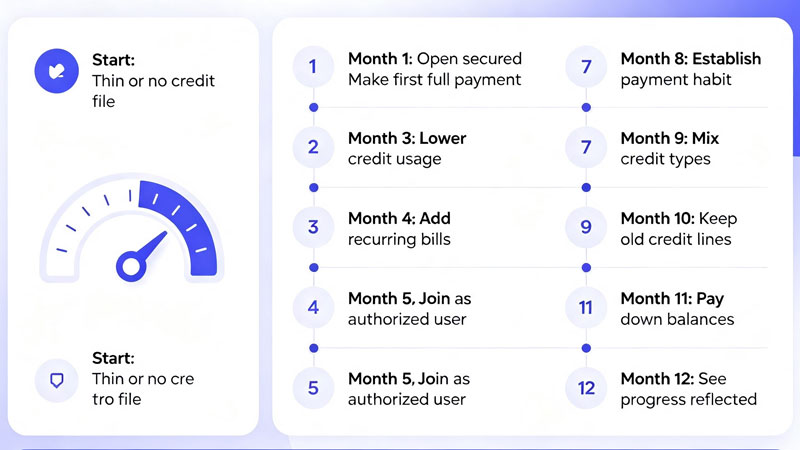
Building Credit From Zero: A Realistic Timeline
- Month 1: Open a secured credit card with a small deposit.
- Months 1–6: Pay the full balance on time, every month.
- Month 6: Apply for an unsecured card or credit-builder loan.
- Month 12: Your score should reflect a solid, if thin, history.
- Year 2: Rent-reporting services and a second account round out your profile.
Strengthening Your Financial Profile Before You Apply
Document checklist:
- Bank statements, 3–6 months
- Two years of tax returns
- Employment verification letter
- Proof of assets (property, investments)
Pull your credit report first. Use AnnualCreditReport.com to check for errors before anyone else sees it.
If you’re carrying debt, understand your options:
| Approach | Effect on Application | Trade-off |
|---|---|---|
| Settle the debt | Cleaner financial picture | Costs cash upfront |
| Structured payment plan | Shows active responsibility | Debt still visible in records |
| Ignore it | No immediate cost | Risk of judgment or collections |
How to read and dispute errors on your credit report
Frequently Asked Questions
Does applying for a visa show up on my credit report?
No. Visa applications aren’t reported to credit bureaus. They’re separate systems entirely.
Will a credit check happen during my visa interview?
Rarely. Standard interviews focus on documents and intent, not credit pulls. Clearance-related jobs are the exception.
Can my spouse’s bad credit affect my green card case?
Only if your spouse is your sponsor. Then their income and debt load matter for the I-864 calculation.
Does bankruptcy affect immigration status?
Not directly. It can raise questions during clearance-related background checks, but it doesn’t trigger automatic denial.
Do other countries check credit history the same way as the U.S.?
No. Requirements vary widely — some countries emphasize proof of funds over any credit check at all. Always confirm with that country’s specific consulate.
The Bottom Line
Your credit score isn’t the gatekeeper here. Your documented financial stability is. Get your paperwork in order, understand your sponsor’s obligations, and don’t let a low score talk you out of applying.
Disclaimer: This article is for informational purposes only and does not constitute legal, financial, or immigration advice. Immigration policy changes frequently. Consult a licensed immigration attorney or a certified financial advisor for guidance specific to your situation.