

Your credit score after divorce won’t tank just because papers get signed. But the financial fallout — joint accounts, closed cards, one income instead of two — can quietly wreck it. Here’s what actually happens, and how to stay ahead of it.
Does Divorce Directly Affect Your Credit Score?
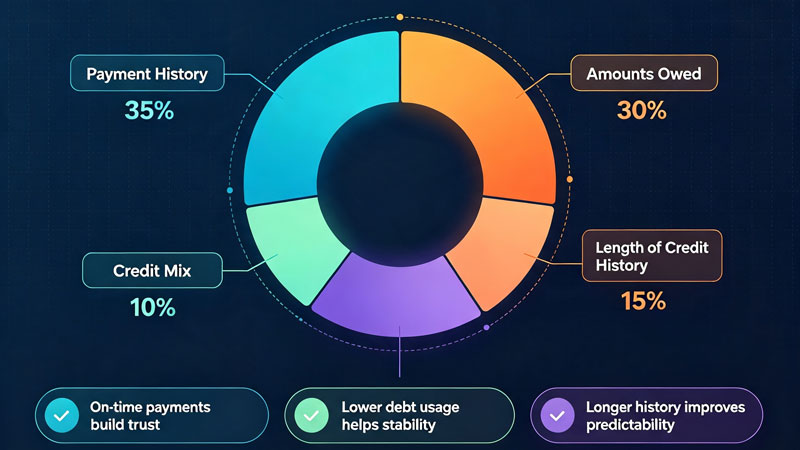
No. FICO and VantageScore models don’t factor in marital status. Never have. Your score is built from five things: payment history, credit utilization, length of credit history, new credit, and credit mix. “Divorced” isn’t a variable in that equation.
What changes is everything around the score. Joint accounts don’t disappear when a marriage ends. Neither does the debt tied to them.
What Shows Up on Your Credit Report During Divorce
Nothing about the divorce itself. What does show up: missed payments on shared cards, new hard inquiries if your ex applies for credit using your info, and any account where you’re still a co-borrower — active or not.
5 Ways Divorce Hits Your Credit Score Indirectly
Income Drops From Two Paychecks to One
Bills don’t shrink just because income does. Missed or late payments start here more often than anywhere else.
Missed Payments on Accounts You No Longer Control
If your name’s on it, you’re responsible — even if your ex agreed to pay it in the settlement.
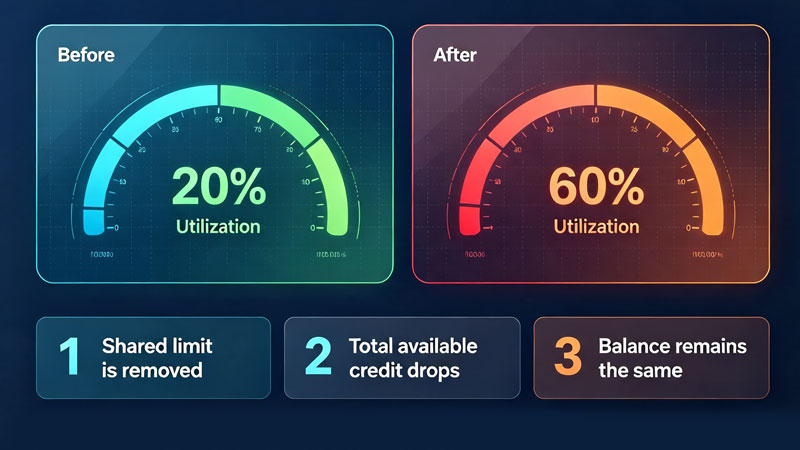
Closing Joint Cards Spikes Your Utilization
Close a card, lose that available credit. Your utilization ratio jumps even if your spending hasn’t changed.
New Debt You Didn’t Know About
A spouse can open new joint credit before a divorce is final. It’s rare, but it happens, and it lands on both reports.
Removed as an Authorized User
If you were only an authorized user — not a joint account holder — getting removed can wipe out years of payment history overnight. Users in this position sometimes see scores drop 20-40 points in a single reporting cycle, simply from losing that account’s age and history.
Why Your Divorce Decree Doesn’t Protect Your Credit
This is the part most people miss until it costs them.
A divorce decree is a court order between you and your ex. Your mortgage lender, credit card issuer, or auto lender was never in that courtroom. They didn’t agree to anything.
Creditors Aren’t Bound by Your Settlement
If the decree says your ex keeps the house and the mortgage, but your name is still on the loan, you’re still liable. The lender will report a missed payment to your credit file the same day it happens — decree or no decree.
A Real Scenario: The Mortgage Nobody Refinanced
Say your ex keeps the house and promises to refinance within a year. They don’t. Eighteen months later they miss three payments. Those late marks land on your credit report too, because your name is still on the note. The only real fix is removing your name from the loan — through refinance or sale — not a paragraph in a settlement.
Community Property States vs. Common Law States
This single detail changes how debt liability actually works for you — and it’s the part almost nobody explains clearly.
What Community Property States Are
Nine states treat most debt acquired during marriage as jointly owned, regardless of whose name is on the account: Arizona, California, Idaho, Louisiana, Nevada, New Mexico, Texas, Washington, and Wisconsin. Alaska allows couples to opt in.
How the Two Systems Differ
| Community Property States | Common Law States | |
|---|---|---|
| Debt during marriage | Generally owed by both spouses | Owed by whoever signed |
| Credit card in one name only | Still may count as shared debt | Typically individual liability |
| Divorce court’s power | Divides debt regardless of whose name is on it | Assigns debt, but creditor still follows original agreement |
If you live in one of the nine states, debt taken on by your spouse during the marriage — even without your signature — can still be treated as jointly owed. That’s a materially different risk profile than someone in New York or Illinois.
community property state divorce laws by state
Step-by-Step: Protecting Your Credit Score During Divorce
Step 1 — Pull and Freeze Your Credit Reports
Check all three bureaus: Experian, Equifax, TransUnion. AnnualCreditReport.com currently offers free weekly reports from each bureau — a policy that’s stayed permanent since the pandemic-era expansion, not a temporary offer. Freeze your reports if you’re worried about new accounts opening in your name.
Step 2 — Separate Every Joint Account
Close what you can. For what you can’t close outright — mortgages, auto loans — refinance into one name as soon as possible.
Step 3 — Refinance or Sell Shared Assets
Selling a joint asset and paying off the loan is often cleaner than refinancing when neither spouse can qualify alone on reduced income.
Step 4 — Set Up Alerts and Monitor Monthly
Payment alerts catch problems before they hit your report. Check your score monthly during the transition, not just once a year.
Joint Account vs. Authorized User: Know the Difference
People use these terms interchangeably. The legal weight isn’t the same.
| Joint Account Holder | Authorized User | |
|---|---|---|
| Legally responsible for debt | Yes, fully | Usually no |
| Can be removed unilaterally | No — needs lender approval | Yes, primary holder can remove anytime |
| Credit history impact if removed | Account stays on report | History can disappear entirely |
Knowing which one you are determines how much control you actually have.
How Utilization and Closures Affect Your Score — With Numbers
Say you have $10,000 in total credit across two cards, with $3,000 owed. Your utilization sits at 30%. Close one card with a $5,000 limit, and your available credit drops to $5,000. That same $3,000 balance now puts you at 60% utilization — a jump that alone can cost 20-50 points depending on your starting score.
Rebuilding Your Credit Score After Divorce
Open a card in your name only. A secured card works if your score took a hit — you deposit collateral, spend small, pay it off monthly.
Most people see visible score movement within 6-12 months of consistent on-time payments. Full recovery from serious damage (missed mortgage payments, high balances) typically runs 12-24 months, not the vague “one to seven years” often quoted elsewhere.
secured credit cards for rebuilding credit
Special Situations Worth Knowing
Does a QDRO affect your credit score? No. A Qualified Domestic Relations Order splits retirement accounts, not credit accounts.
Joint tax debt. If you filed jointly during the marriage, the IRS can pursue either spouse for the full balance — this can eventually show up as a lien on your credit report.
Ex files for bankruptcy. Their bankruptcy doesn’t erase your liability on joint debt unless you were also included in the filing.
FAQ
Does divorce show up on a credit report?
No. Only account activity — missed payments, closures, new debt — shows up, not marital status.
Can I remove my ex from a joint credit card without their consent?
No. The lender must approve any change to a joint account. One party can’t remove the other unilaterally.
How long does it take to rebuild credit after divorce?
Most people see measurable improvement in 6-12 months with on-time payments and low utilization. Serious damage takes 12-24 months to fully recover.
Does divorce affect my ability to get a mortgage?
It can, mainly through income changes or new debt. Lenders will want your divorce decree, proof of support payments, and updated income documentation.
What if my ex refuses to pay their share of joint debt?
The lender doesn’t care what the decree says. If your name is on the account, you’re liable. Refinancing the debt out of your name is the only permanent fix.
Disclaimer: This article is for educational purposes only and does not constitute financial, legal, or credit advice. Please consult a licensed financial advisor or family law attorney for guidance specific to your situation.