

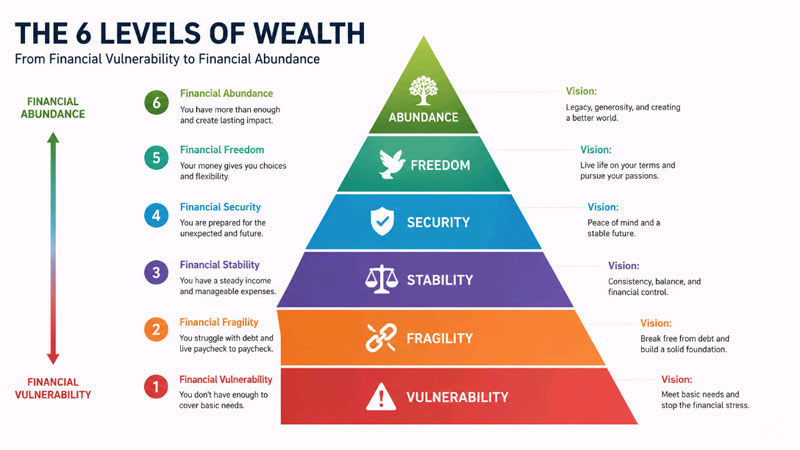
Most people confuse being rich with being wealthy. Wealth levels aren’t about your paycheck or your car lease. They’re about how much room you have between what you earn and what you owe. This guide breaks down six clear stages, backed by current net worth data, so you can pinpoint exactly where you stand — and what actually moves you forward.
What “Wealthy” Actually Means (It’s Not Your Income)
Income pays your bills. Net worth builds your options. That’s the entire distinction, and most financial content glosses over it.
Rich means high cash flow with little to show for it — a $300,000 salary and $40,000 in savings. Affluent means comfortable margin, but the asset base is still growing. Wealthy means your assets could support your lifestyle even if the paycheck stopped tomorrow.
| Category | Income | Assets | Time Freedom |
|---|---|---|---|
| Rich | High | Low-moderate | Low |
| Affluent | Moderate-high | Growing | Moderate |
| Wealthy | Variable | High, liquid | High |
There’s no single number that flips a switch. A recent Schwab Modern Wealth Survey found most Americans peg “wealthy” at a net worth north of $2 million — yet plenty of people who cross that line still don’t feel it. consumer sentiment on wealth perception
How Many Americans Are Actually Wealthy?
Millionaire headlines get thrown around loosely. The real number depends on whether you’re counting total net worth or just liquid, investable assets — and those two figures tell very different stories.
According to Federal Reserve Survey of Consumer Finances data, roughly 1 in 9 U.S. households qualifies as a millionaire by total net worth. Strip out home equity and count only investable assets, and that share drops sharply. household net worth statistics by asset type
Net Worth Benchmarks by Age
Age matters more than most wealth frameworks admit. A 28-year-old with $50,000 saved is ahead of schedule. A 55-year-old with the same number is behind.
| Age | Median Net Worth | Top 10% Net Worth | Typical Wealth Level |
|---|---|---|---|
| 25–34 | ~$40,000 | ~$300,000 | Level 1–2 |
| 35–44 | ~$135,000 | ~$800,000 | Level 2–3 |
| 45–54 | ~$250,000 | ~$1.6M | Level 3–4 |
| 55–64 | ~$365,000 | ~$2.5M | Level 4 |
| 65+ | ~$410,000 | ~$3M | Level 4–5 |
Figures approximate current Fed SCF data; confirm the latest release for precise numbers.
The 6 Levels of Wealth, Explained
We built this framework around three inputs: net worth range, savings rate, and how many months of expenses your assets could cover without a paycheck. That’s the methodology — no guesswork.
Level 0: Financial Vulnerability
Negative or near-zero net worth. Debt outweighs assets. This stage gets skipped in most wealth articles, but it’s where a large share of adults actually live.
Watch for: high-interest debt stacking faster than income grows, no buffer for a single emergency.
Progress looks like: building even a $1,000 starter emergency fund and stopping new debt from accumulating.
Nearly 4 in 10 Americans can’t cover a $400 emergency expense without borrowing or selling something. That’s Level 0, in one statistic. emergency savings shortfall statistics
Level 1: Financial Stability
You cover your bills without stress. A basic emergency fund exists — ideally three to six months of expenses.
Trap: treating “stability” as the finish line instead of the starting point.
Success marker: zero credit card debt and a savings habit, even a small one.
Level 2: Financial Strategy
Your money now has a plan beyond a checking account. This is where retirement accounts start doing real work.
For 2026, confirm current IRS contribution limits before maxing out a 401(k) or Roth IRA — these figures adjust annually. retirement account contribution limits guide
Benchmark: a 15% savings rate is the floor. 20–25% puts you meaningfully ahead of the median saver.
Level 3: Financial Security
Small purchases stop triggering anxiety. You can afford the coffee, the flight, the nicer dinner — without checking your balance first.
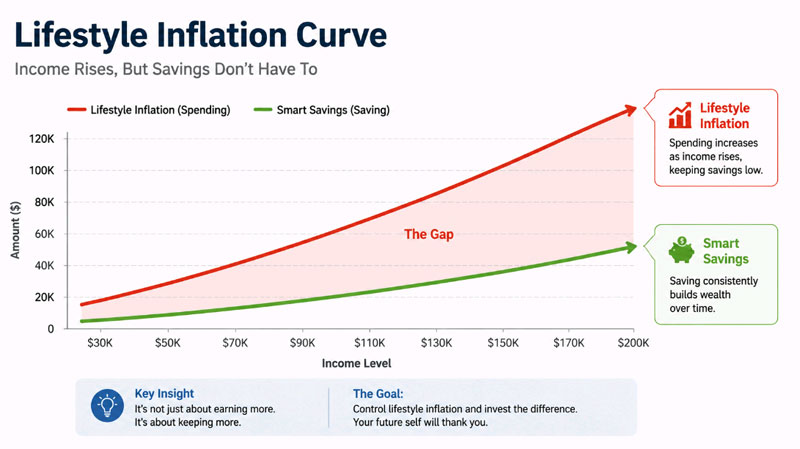
Trap: lifestyle creep. Research on spending behavior consistently shows that expenses rise to match income unless savings rates are automated and protected. Set your savings rate as a fixed percentage, not a leftover.
Success marker: you could absorb a major unplanned expense without derailing your plan.
Level 4: Financial Freedom
Work becomes optional. Your assets can fund your lifestyle indefinitely.
The classic Stanley & Danko formula — age × income ÷ 10 — estimates expected net worth. To hit “Prodigious Accumulator” status, you need double that figure. It’s a useful gut check, but it penalizes young high earners whose income hasn’t caught up to their long-term trajectory yet. If you’re under 40, weight savings rate and asset growth more heavily than this formula alone.
calculate your financial freedom number
Level 5: Financial Abundance
Money stops being the constraint. Decisions shift toward legacy, giving, and how you want to be remembered financially.
This stage often involves donor-advised funds, trusts, or structured charitable giving — tools that deserve a licensed advisor’s input, not a DIY approach.
How to Calculate Your Own Net Worth
This is the step competitors skip. Here’s the actual math.
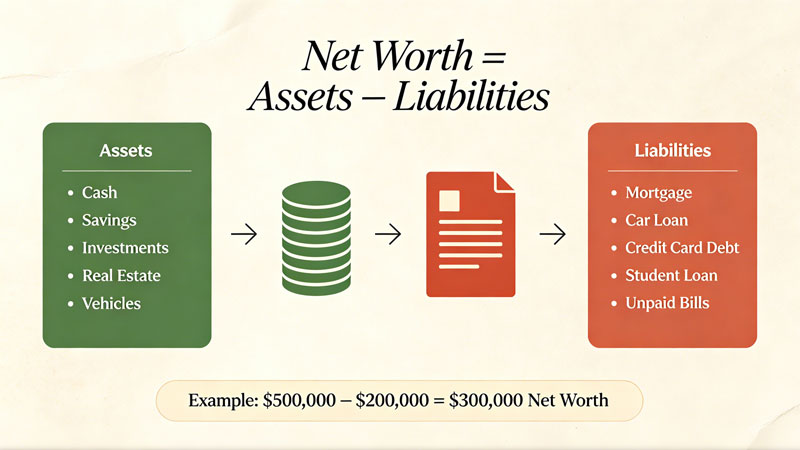
Net Worth = Total Assets − Total Liabilities
Count as assets: cash, retirement accounts, brokerage accounts, home equity, business equity.
Don’t count: cars, furniture, or other depreciating personal property — they inflate the number without reflecting real financial strength.
Common mistakes:
- Using a home’s full value instead of equity (value minus mortgage balance)
- Ignoring debt that isn’t monthly (medical bills, tax owed)
- Counting a car’s purchase price instead of resale value
Does Where You Live Change Your Wealth Level?
Yes — and this gets ignored constantly. $150,000 net worth in rural Ohio and $150,000 in San Francisco represent two completely different realities. Regional price parity data shows real purchasing power can swing by 20% or more across metro areas. Adjust your benchmarks accordingly before comparing yourself to national averages.
Common Mistakes at Every Wealth Stage
- Skipping insurance to “save” money, then facing a six-figure setback
- DIY-ing complex tax or estate situations that need a CPA or estate attorney
- Measuring progress against income instead of net worth
- Never updating the plan as income or family situation changes
FAQ: Wealth Levels
What net worth is considered wealthy in 2026?
Most surveys place the “wealthy” threshold around $2 million net worth, though this varies by region and lifestyle expectations.
Is $1 million enough to retire comfortably?
It depends on spending needs and location. $1 million supports a modest retirement in low-cost areas but may fall short in expensive metros.
What’s the difference between rich and wealthy?
Rich describes high income and visible spending. Wealthy describes assets that could sustain your lifestyle without a paycheck.
How do I know what wealth level I’m at?
Calculate your net worth, compare it to your age bracket’s benchmark, then check your savings rate and expense coverage against the six levels above.
Does income or net worth matter more?
Net worth. Income disappears without a plan; net worth compounds with one.
Where You Stand Is a Starting Point, Not a Verdict
Wealth levels shift as income, debt, and habits change. The number that matters isn’t where you rank today — it’s whether this year’s habits are moving you up a level or holding you in place.
Disclaimer: This article is for educational purposes only and does not constitute financial, investment, tax, or legal advice. Net worth figures and contribution limits cited reflect publicly available data at the time of writing and are subject to change. Consult a licensed financial advisor, CPA, or attorney before making decisions based on your personal financial situation.