

You need a medallion signature guarantee — and you need it before your securities transfer stalls. Most people hit a wall here: their bank says no, their broker doesn’t offer it, and Google gives them vague answers. This guide cuts through that. Below, you’ll find every legitimate place to get one, what each option costs, what documents to bring, and exactly what to do if you get turned down.
What Is a Medallion Signature Guarantee (And Why Can’t a Notary Replace It)?
A medallion signature guarantee (MSG) is a stamped, signed certification issued by an authorized financial institution. It confirms three things: your identity is verified, your signature is genuine, and you have legal authority to transfer the securities in question.
Here’s the key difference most people miss: the institution issuing the stamp is putting its own money on the line. If the transaction later turns out to be fraudulent, the guaranteeing institution bears financial liability — not just moral responsibility.
A notary public cannot do this. A notary verifies identity for legal documents. They carry no financial liability for securities fraud. Transfer agents know the difference, and they will reject a notarized form when an MSG is required.

Quick comparison:
| Medallion Signature Guarantee | Notary Public | |
|---|---|---|
| Issued by | Authorized bank officer | Licensed notary |
| Financial liability | Yes — institution’s assets | None |
| Accepted for securities transfers | Always | Rarely |
| Typical cost | Free–$50 | $5–$25 |
When Do You Actually Need One?
You’ll typically need an MSG when:
- Transferring securities from a deceased person’s account to an heir
- Changing the name on a brokerage account after marriage or divorce
- Moving assets from an individual account into a joint account
- Gifting a stock portfolio to a family member
- Consolidating multiple brokerage accounts
When in doubt, call the receiving institution’s transfer agent first. Requirements vary. Don’t assume.
Where Can You Get a Medallion Signature Guarantee? 5 Ranked Options
Option 1: Your Primary Bank — Start Here
This is your best first move. Major U.S. banks — including Chase, Bank of America, Wells Fargo, and Citibank — participate in the STAMP program (Securities Transfer Agents Medallion Program), which covers over 7,000 institutions across the U.S. and Canada.
SEC’s official overview of medallion signature guarantee programs
Most banks provide MSGs free to established account holders. The catch: you typically need to have held the account for at least 30 to 90 days, and the transaction value must fall within the branch officer’s surety limit.
Before you go, call ahead and ask:
- “Do you provide medallion signature guarantees for account holders?”
- “What is your maximum coverage limit per transaction?”
- “Which documents do I need to bring?”
Not every branch keeps a credentialed officer on-site daily. A five-minute call saves a wasted trip.
Option 2: Credit Unions — Underrated and Often Free
Credit unions are frequently overlooked. If you’re a member, many offer MSGs at no charge as a standard account benefit.
The limitation: credit unions often carry lower surety limits — commonly $100,000 to $500,000 per transaction. If you’re transferring a high-value portfolio, confirm the limit before booking an appointment.
To find a credit union near you that participates in a medallion program, use the [guide to finding NCUA-member credit unions offering financial services] on the NCUA’s institution locator.
Option 3: Your Brokerage Firm’s Physical Locations
If your brokerage has investor centers or branch offices, this is worth checking. Fidelity Investments, for example, explicitly provides medallion signature guarantees at its Investor Centers to account holders — no bank account required.
Charles Schwab branches offer similar services. TD Ameritrade’s services have largely been absorbed into Schwab following their 2020 merger.
Important: Online-only brokerages — Robinhood, Webull, M1 Finance — do not offer MSGs. If your assets are held there, you’ll need to go through a bank or credit union.
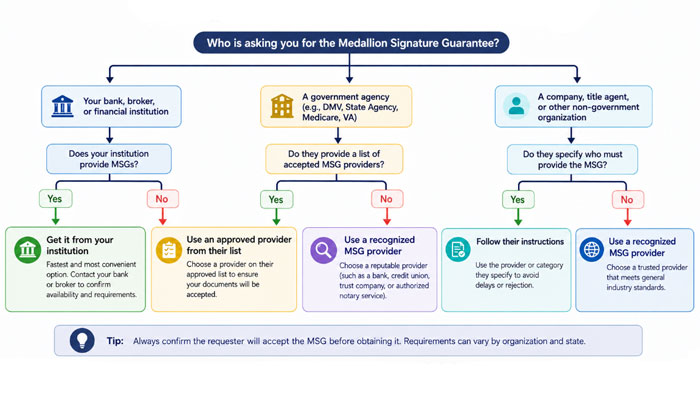
Option 4: Third-Party Medallion Signature Guarantee Services
This option didn’t exist at scale five years ago. It matters now.
Several third-party providers offer MSG services — useful if you live in a rural area, are traveling, or your local institutions keep turning you away. These firms are registered members of recognized medallion programs and operate legally.
Fees typically run $75–$150 per transaction, sometimes higher for large-value or complex transfers.
One critical check: Before paying anything, verify the provider is an actual member of STAMP, SEMP, or MSP. Ask for their program membership number. Fraudulent “medallion guarantee” services exist. A legitimate provider will have no hesitation confirming their credentials.
Option 5: For Non-U.S. Residents
Getting an MSG outside the United States is genuinely difficult. The most practical path: work through a U.S.-based financial institution where you already hold an account — some major banks with international operations can facilitate this.
Alternatively, certain specialized services operate internationally. Verify their medallion program membership as you would with any third-party provider.
Contact the transfer agent at the receiving institution directly. They deal with international transfers regularly and can often point you toward a viable solution — or tell you upfront whether an alternative verification method is acceptable in your specific case.
How to Get a Medallion Signature Guarantee: Step-by-Step
Step 1 — Confirm you need one. Call the transfer agent at the receiving institution. Don’t assume.
Step 2 — Gather your documents. Most institutions require:
- ☑ Government-issued photo ID (passport or driver’s license)
- ☑ Completed securities transfer form
- ☑ Recent account statement showing your name and asset details
- ☑ If inherited: death certificate + letters testamentary
- ☑ If name change: legal name change documentation
- ☑ If acting for another person: notarized power of attorney
- ☑ For corporate accounts: corporate resolution documents
Step 3 — Call ahead. Confirm the branch has an authorized officer available, and that their coverage limit covers your transaction value.
Step 4 — Attend in person. Only an authorized bank officer — typically a branch manager or designated officer — can issue the stamp. Remote or online issuance is not standard, though some third-party services have adapted hybrid processes.
Step 5 — Use it promptly. An MSG has no official expiration date. In practice, transfer agents typically require you to use it within 60 to 90 days of issuance. If your transaction is delayed, you may need a fresh stamp.
How Much Does a Medallion Signature Guarantee Cost?
| Provider Type | Typical Cost | Notes |
|---|---|---|
| Your own bank | Free | Standard for established account holders |
| Credit union | Free–$25 | Member benefit; confirm surety limits |
| Fidelity / Schwab branch | Free | Must be an account holder |
| Non-customer at a bank | $10–$50 | Policy varies; some banks decline outright |
| Third-party service | $75–$150+ | Higher for complex or high-value transactions |
What to Do If You Can’t Get One
Your bank doesn’t offer MSGs. Open an account at a bank that does — Chase and Bank of America are reliable options — and allow the account to season for the institution’s minimum period (typically 30–90 days).
Your transaction exceeds the coverage limit. Ask whether the transaction can be split. Alternatively, obtain partial guarantees from multiple institutions. For very high-value transfers, work directly with the transfer agent — they’ve handled this before.
You’ve been turned down mid-process. The most common reasons: account too new, incomplete documentation, or the transaction value exceeds the officer’s authorized limit. Address the specific reason directly. If the process has become genuinely complex — estate disputes, legal name discrepancies, international complications — consult a securities attorney.
FAQ
Can I get a medallion signature guarantee online?
Not through traditional banks. Some third-party providers offer hybrid remote processes, but in-person verification remains the standard. Expect the process to require at least one in-person appointment.
Does Chase Bank offer medallion signature guarantees?
Yes. Chase participates in the STAMP program and provides MSGs to established account holders at branch locations. Call your local branch to confirm availability and book an appointment.
How long is a medallion signature guarantee valid?
There is no official expiration, but transfer agents typically expect the stamp to be used within 60–90 days. A stamp sitting unused for six months will likely be rejected.
Can a notary replace a medallion signature guarantee?
No. A notary verifies identity for legal documents but carries no financial liability for securities fraud. Transfer agents require the institutional backing that only an MSG provides.
Do I need an MSG to transfer a Roth IRA?
It depends on the institutions involved and how the assets are held. Contact the receiving institution’s transfer agent to confirm requirements before initiating the transfer.
Disclaimer
The information in this article is for educational purposes only and does not constitute financial, legal, or investment advice. Requirements for medallion signature guarantees vary by institution and transaction type. Consult a licensed financial advisor, securities attorney, or qualified tax professional before making decisions about securities transfers or estate-related financial matters.